

South America and Antarctica (2018) Diary
8-1-2018
Monday
We start with very long journey from Brisbane,
up at 5am to catch a taxi at 6am, to board a Qantas flight scheduled for 8.15am
for the first leg of 3 hours duration. After a change to Latin American airlines
(LATAM) at Auckland (NZ) we continued on the next 11 hour leg to Santiago
(capital of Chile) where we stayed at the Providencia Hotel for 1
night. Unfortunately our bags did not arrive on the same flight which was a
problem because we had another 2 flights in the morning, out of the country, to
Quito in Ecuador! We had kept our transfer driver, Gabriel, waiting over 2 hours
while we waited, and waited, and waited for our bags to come through the
carousel. We were very happy and surprised that he waited for us, especially as
we didn't have mobile phone access and no way to contact him. He took down the
details of our missing bags and reported back to Chimu Adventures, the company
that did all our bookings.
After a couple chats (with a bit of difficulty due to the language barrier) with
the lost baggage staff, a report was filled out and we'll have to chase it up
ourselves later. So we only had our cabin bags to rely on for the 2 days it took
before our big bags eventually caught up with us. Luckily we had packed a change
of clothes and important medication in our cabin bags, however it was still
depressing and very inconvenient. In all our years of travel we have been lucky
and never experienced our bags not be on our flight, until now - and hope it
never happens again. After booking into our hotel Dave went out and bought some
toothpaste and brushes to tide us over.
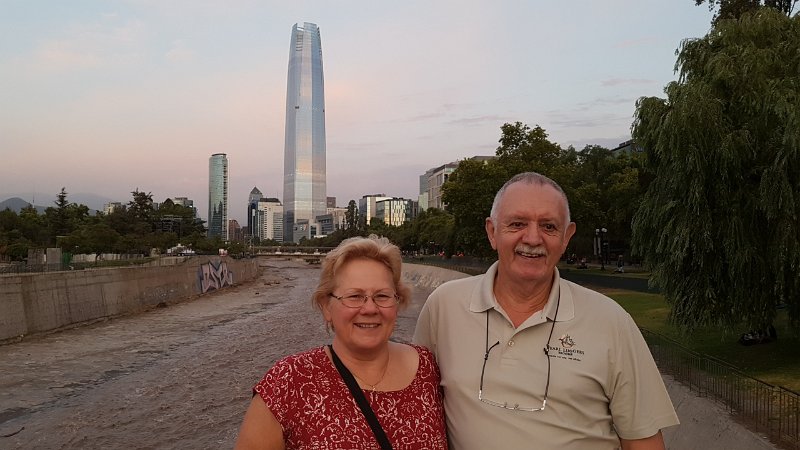
After we settled in we went downstairs to the restaurant where we had a free
welcome drink, which was a local alcoholic drink called "pisco sour".
I'd read about this drink in several bits of literature to do with Sth America
and so was interested to try it. It was 14% alcohol and very sickly sweet, too
much for my liking. It seems the 'sour' taste is to do with there being lemon as
one of the ingredients. After that we went out for a walk around, down to a
nearby bridge over a river with not much water in it, but little there was, was
running pretty fast. There were some sculptures near the bridge that were
quite interesting. We had a nice and reasonable dinner at a restaurant called Lomit's,
with very good natured and helpful staff.
9-1-2018 Tuesday
Next morning we were up at 1am to be ready for our 2am transfer back to Santiago
airport, for our next leg to Lima (capital of Peru), and then onward to Quito
(capital of Ecuador) and the Hilton Hotel for 1 night. As we checked
in for our flight at Santiago we asked the lady to check if there was any
progress with our bags and she said they were being sent to Quito but we were a
bit unsure about it all. When we were waiting in line for our second flight leg
to Quito they made us wait for a very long time, even though the flight had been
called to board with only one woman doing the check ins. It ended up being at
least 45 mins late, but then we had been told Sth America is notorious for
flight problems.
When we arrived at Quito we didn't bother checking the carousel for our bags and
went straight out to our next waiting transfer driver, Jorge (pronounced 'Horhay'
or 'George', whatever was easier to remember). We told him about our bags
problem and, as we were flying out to the Galapagos Islands tomorrow, he said we
should chase it up now, and he helped us which was fantastic. We went to the
baggage claim area and it ended up that our bags were going to be on a flight
arriving at 2.30am next morning and so we should check at the airport before our
flight next morning. These 2 days were a long and tiring journey even with the
benefit of a gain of 15 hours between Brisbane and Quito.
After settling in at our hotel we got an adaptor from reception so we could at
least charge our phones - all our cords and adaptors were in our big bags of
course. In the morning we were going to Galapagos for 4 nights so in case we
still didn't end up getting our bags, we then went out and bought some things,
some socks for the both of us, a pair of shorts for Dave so he didn't have to
swim and snorkel naked, and a hair brush for me as I felt 2 days was my limit
for not brushing my hair! After that we found a place for an early dinner and
went back to the hotel for a 5pm information meeting for the Galapagos trip
tomorrow.
10-1-2018 Wednesday Day 1 Galapagos Islands
Ecuador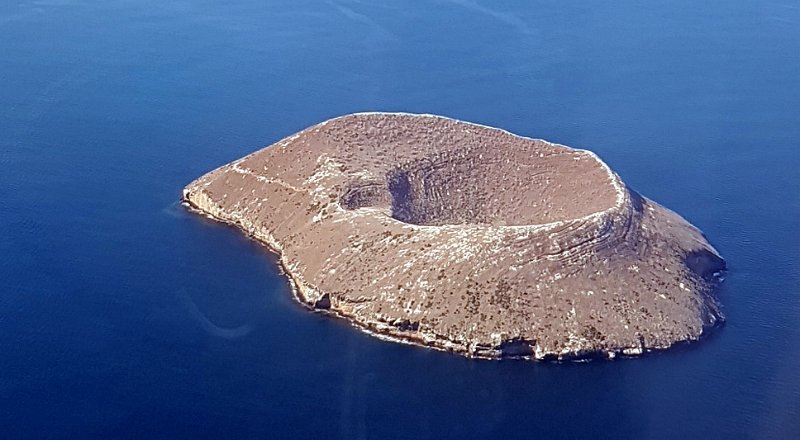
Galapagos
The Galápagos Islands is a volcanic archipaelago in the Pacific Ocean.
It's considered one of the world's foremost destinations for wildlife-viewing. A
province of Ecuador, it lies about 1,000km off its coast. Its isolated terrain
shelters a diversity of plant and animal species, many found nowhere else.
Charles Darwin visited in 1835, and his observation of Galápagos' species later
inspired his theory of evolution. It is a National Park and visitation by people
and boats is controlled. The islands are forever changing as they are the result
of active volcanoes.
We were up at 3.30am(!!) for a 4am breakfast (never had breakfast that early
before) at the hotel and then a 4.30am bus transfer to the airport for our 6.50
flight. Our G Adventures guide, Vivianna, booked us all in (4 other people) and
then took us to see about our missing bags. After a fair while of checking the
lady told us the bags were there but they couldn't get in to the locked room.
There was going to be a later afternoon flight to Galapagos and so she would
make sure they were on that flight, but while we were waiting in the lounge for
our boarding call, I was paged and told our bags would be on the same flight we
were on - yay!! Luckily they were. We were going to buy a couple simple hats at
the airport to tide us over but they were US$35 so we decided to forget it,
luckily. On the 3 hour flight we had a short refueling stop and exchange of
some passengers in the town of Guayaquil.
On arrival we had to pay in cash a US$20 each for a transit control fee and
US$100 each national park fee.
The National Park charges a visitor fee of US$100, payable on arrival, which
funds park maintenance and supervision in the Galápagos as well as ecological
study, conservation, and infrastructure development in Ecuador's other National
Parks. Entry fees and the funds they generate for the National Park System are
among measures taken by the Ecuadorian government to protect its natural
heritage.
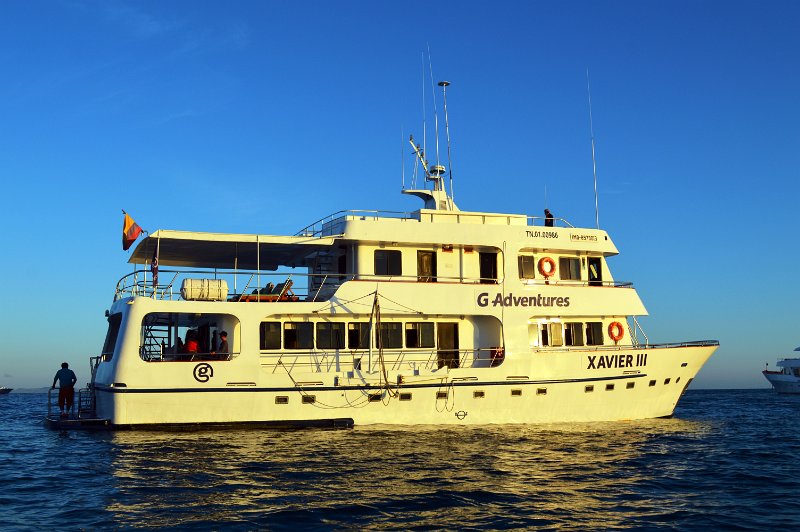
Our destination on the the Galapagos Islands was a boat, the Xavier
III for 4 nights. There were 16 guests (all nice people) on board, from 6
different countries, 7 if we counted the Ecuadorian staff. We landed at the Mariscal
Sucre International Airport – Baltra Island
airstrip, built by the
American soldiers in WWII. After paying our fees we caught a bus down to the
ferry, got off the bus and onto the ferry to cross over to Santa Cruz Island,
got on another bus (about 30 mins) to the port of Puerto Ayora, where we
boarded a Zodiac (inflatable boat) that transported us to our floating hotel,
the Xavier III. The water was a beautiful clear blue/green, a lot like we saw in
Hawaii. On an adjacent pontoon there were a couple sea lions sunning themselves
and we could see a couple small turtles in the water. Some iguanas were sunning
themselves on the rocks beside the jetty - we are amongst the marine life
already!
Our Naturalist Guide for the 4 days was another Jorge (Horhay or George,
whichever one you wanted to call him). He is a marine biologist, who spoke very
good English and knew every type of wildlfe on and around the Galapagos islands.
Our small room had twin beds and a small bathroom. Having our big bags with us
caused more work for the people who had to load them on and off the various
transport modes (bus, ferry, zodiac and our boat Xavier III), up the spiral
steps to our room and made storage in our room a little more difficult, but it
couldn't be avoided. Normally we'd have left our big bags in storage at the
hotel and just packed our smaller trundle bags with the necessities for 4 days.
On board the Xavier we had a briefing about safety and the rules of life on the
boat and then had a nice lunch. Meals on the boat were great - each 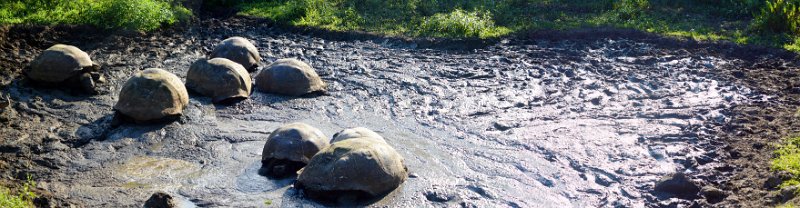 meal was a
buffet and I don't think we had the same lunch and main meal repeated. After
lunch we boarded the Zodiac back to the pontoon to get a bus to visit a giant
tortoise ranch in the Santa Cruz's verdant highlands, and get up close and
personal with these ancient creatures in their natural environment. It was
called El Chato Tortoise Ranch - Jorge told us that 'El Chato' meant
'short person' and the term was used to refer to someone of short stature, and
probably not meaning a compliment. We saw lots of giant tortoises wandering
around, eating, wallowing in the mud to keep cool, even a couple mating, or
trying to mate. The male had a few goes but didn't seem to know which direction
was right, as he tried a couple different approaches with the same female, who
remained oblivious and unhelpful, and hidden inside her shell - it's just as well
they live to about 150 years - sooner or later he'll get it right. It's so
exciting to be here and see these majestic creatures firsthand, instead of just
on David Attenborough's (the 'bro') TV show.
meal was a
buffet and I don't think we had the same lunch and main meal repeated. After
lunch we boarded the Zodiac back to the pontoon to get a bus to visit a giant
tortoise ranch in the Santa Cruz's verdant highlands, and get up close and
personal with these ancient creatures in their natural environment. It was
called El Chato Tortoise Ranch - Jorge told us that 'El Chato' meant
'short person' and the term was used to refer to someone of short stature, and
probably not meaning a compliment. We saw lots of giant tortoises wandering
around, eating, wallowing in the mud to keep cool, even a couple mating, or
trying to mate. The male had a few goes but didn't seem to know which direction
was right, as he tried a couple different approaches with the same female, who
remained oblivious and unhelpful, and hidden inside her shell - it's just as well
they live to about 150 years - sooner or later he'll get it right. It's so
exciting to be here and see these majestic creatures firsthand, instead of just
on David Attenborough's (the 'bro') TV show.
We saw a couple of lagoons with different types of bird life, gulls, even some
flamingoes, which we thought only existed in Africa. We descended down into a
lava tube or tunnel, formed long ago when flowing lava has cooled on the outside
forming a shell, and leaving a large cylindrical space inside to walk through,
once the lava had ceased to flow. We have seen these lava tunnels before, back
in Australia and in Hawaii. On the way back to the boat we stopped at and old dormant volcanic
crater, covered with vegetation.
The ship travels at night so you wake up in a new destination, ready to explore
picturesque views of the Galápagos from the outdoor deck. On our cabin's deck
there was a well used space with deck chairs where guest sat to enjoy the
scenery and fresh air, whilst relaxing and enjoying their own personal past
times. On this first night we were introduced to the Captain and crew (of about
7) with a welcome cocktail and a nice dinner.
11-1-2018 Thursday Day 2 Galapagos Islands
Ecuador
Last night we up-anchored about 12-1am and motored to the small Rabida Island.
After breakfast we hopped into the zodiacs and motored ashore to Bachas Beach
where we had a 'wet' landing i.e. we swing our legs over the side and drop down
into a half a metre of water before walking to the beach. We dropped our gear on
the beach and went for a walk around the island on volcanic gravel. Our gear was
safe as most of the time we didn't see any other boats, only the occasional
couple tourist boats, so it felt like we owned the place, all on our own - a
wonderful feeling.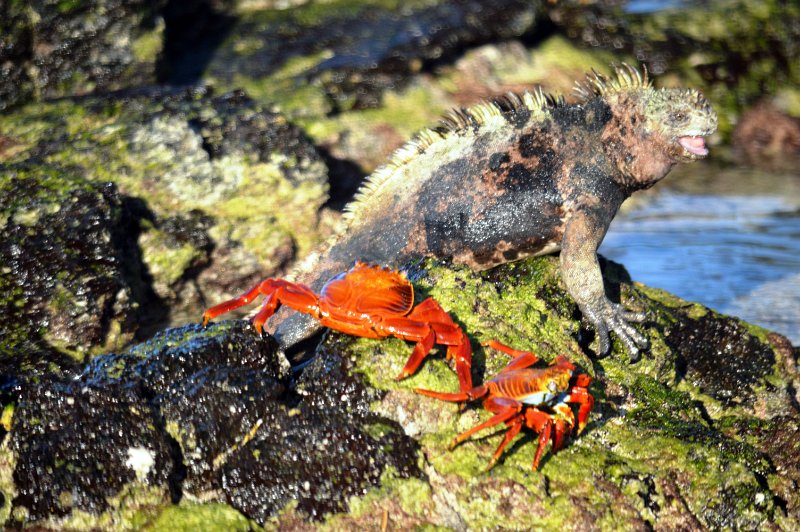
We saw many cacti, big and small, many with round buds growing out of the paddle
like plant, ready to flower - mostly here we saw yellow ones. Back at the beach
everyone went snorkeling, except me - I was happy just to go wading. We
saw sea lions frolicking and many small orange and yellow crabs called Sally
Light Foot
crabs, the baby ones, coloured black, loved by the Herons and
other birds. Back to the Xavier for lunch and then we drove around to the north
west side of Santa Cruz Island. About mid afternoon we hopped in the zodiac
again to hop off on the beautiful white sandy beach (like our Aussie beaches) to
see a couple flamingoes, marine iguanas on the rocks, Frigate birds,
Pelicans (differently coloured to ours) and the ever present and in large
numbers, the orange and yellow Sally Light Food crabs - these crabs will eat
anything they can get their claws on!
Jorge showed us the very clear 'drag' tracks in the white
sand, up out of the
water and back down to the water, made by the Green Turtle as it makes
its way to lay its eggs in the sand. The sand is made of decomposed coral,
making it soft and white, and a favourite site for the nesting sea turtles.
Further along were metal remains (up to half a metre tall) of landing platforms
for barges from long ago. Marine iguanas were on the sand, feeding on the mossy
rocks and occasionally in the water. The weather has been beautiful. At one
place we saw big and small Stingrays as well.
12-1-2018 Friday Day 3 Galapagos Islands
Ecuador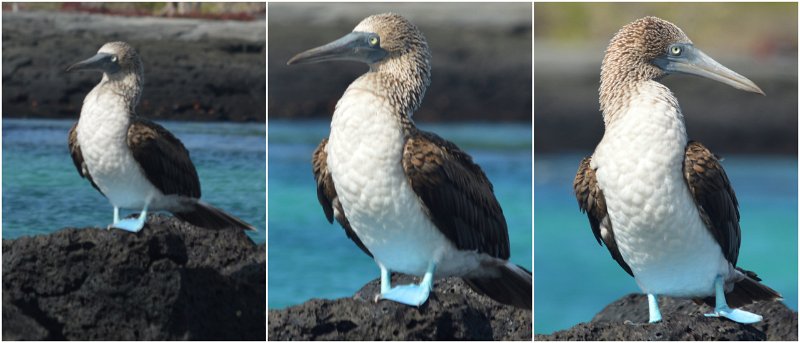
Overnight we motored to Floreana Island and the only landing site, Punta
Cormorant. After breakfast we boarded the zodiac to the beach and Jorge took
us on a guided walk to observe the bird and wildlife and learn about the natural
history. Back on the zodiac we saw White Tip Sharks in the water and Blue
Footed Boobies on the rocks - they had really pretty light sky blue legs and
webbed feet. Apparently there are also Red Footed Boobies and Masked Boobies.
Back on board Xavier motored around to Champion Islet for snorkeling,
right off the zodiac (not off the beach) so in deeper water. I didn't want to
sit in the zodiac or stay in the deep water all the time, so I stayed back on
board Xavier during this activity. The deeper water meant they could see more,
and different marine life.
After lunch we hiked uphill to Baroness Viewpoint from which we had a
great view over the landscape and water. More snorkelling off the beach - Dave
didn't want to snorkel this time so we went for a walk along the beautiful
beach. We saw some small penguins in the water but not many. We visited Post
Office Bay, home to the famous barrel that served as the mailbox for the
18th century whaling ships. English whaling vessels placed a barrel here to be
used as a post office - people would post letters in the barrel hoping that they
would be picked up by others heading to that destination, and deliver the
letter. Today, the box is used mainly by tourists, who may drop off an addressed
card/letter and pick up a different unstamped addressed card/letter to their own
country, take it home and post it.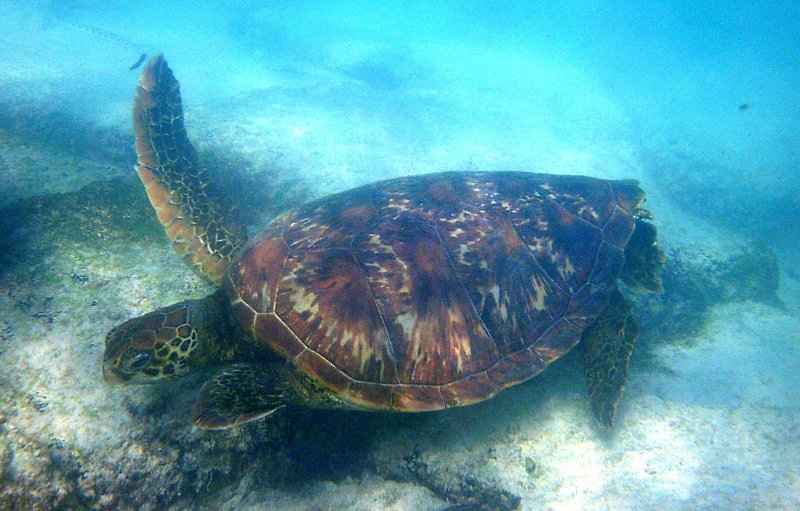
This afternoon we saw plenty of green turtles in the water and Dave was really
excited when one actually came up quite close to his face for a look, while snorkeling.
13-1-2018 Saturday Day 4 Galapagos Islands
Ecuador Last Day
Overnight Xavier drove to Espanola Island, the southernmost island in the
Galápagos archipelago. After breakfast we zodiaced to Punta Suarez
where there were an abundance of Sea Lions, Marine Iguanas, Albatrosses
and Masked Boobies with big white
fluffy baby chicks like cotton balls.
The chicks looked bigger than the adults with their downy feathers fluffed up.
The iguanas were so large in number that they sunned themselves on the path that
we had to walk, and we had to step over them - they didn't move. It was mating
season and the males are a pretty pink and green colour, but they are ugly, and
beautiful at the same time (I think like a bull terrier). They actually remind
me of the movie Gremlins, made many years ago, where the cute fluffy small
creature turns into an ugly nasty looking creature if you feed/water it after a
certain time at night.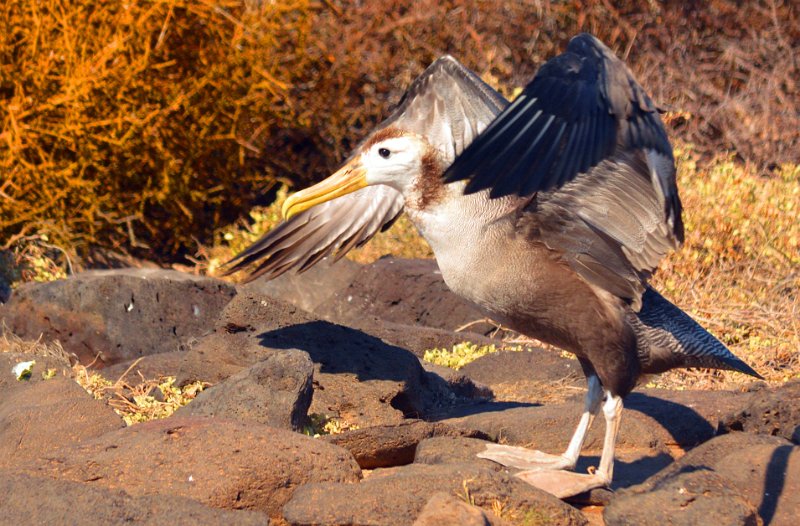
It was a treat to see the Albatrosses first hand, especially as in a short time
from now Jorge told us they would be gone from this place, due to the changing
weather and winds, which they need to gain flight off these cliffs. There was a
young one, testing its wings, taking a run at the cliff's edge, but stopping
short as it wasn't ready yet. We didn't see it fly while we were there but it
was very close. We saw a nursery of sea lion pups and we were mesmerised
and delighted by their playfulness with each other, and even coming up close to
us, full of curiosity.
Back on board we drove to Gardner Bay and after lunch, more snorkeling off the zodiac (not off the beach). Dave and I didn't go. Apparently there are
large schools of big tropical fish here, including Yellow-tailed Surgeonfish,
King Angelfish, and Bump-head Parrot fish. Back on board, we drove a short
distance to where we did a 'wet' landing and walked to the beach. It was a
picture post card - white sandy beach, beautiful turquoise water like Hawaii, no
buildings, and many sea lions just lazing on the beach, soaking up the sun.
There were a couple very small georgeous pups lying close to their Mums. Looking
out toward the water we saw only our boat waiting for us and a couple rocky
islands in the distance - peaceful bliss!!
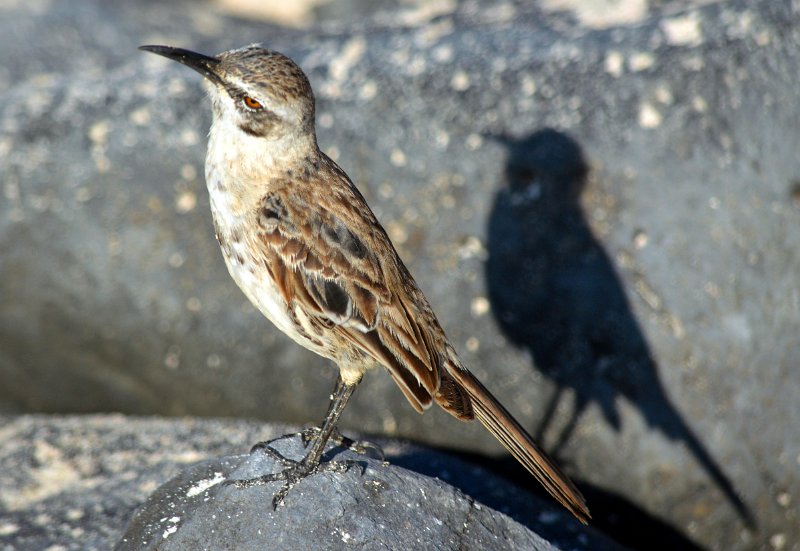
We saw a few Mockingbirds, small birds hopping around and very curious,
confident to come right up close to you, looking up at you to check you out.
Back on board, before dinner, we drove to and anchored near San Cristobal
Island, our last stopover to explore tomorrow, before flying back to the
mainland.
14-1-2018 Sunday
This morning we packed our bags, had breakfast and ferried by zodiac to San
Cristobel Island. We visited the Darwin Interpretation Centre first,
where you could learn everything you wanted to know about the Galápagos from
the islands' natural history to their ecosystems and flora and fauna. Charles
Darwin visited here and was blown away by the extent of bird and marine life.
Then we had some free time to walk around, bought some souvenirs and had a drink
with a couple of the passengers at a cafe before being bussed to the airport. We
arrived back in the late afternoon to a rainy Quito
(Ecuador) and the Hilton Colon Hotel for 3 nights.
15-1-2018
Monday
We came back to a rainy Quito yesterday and it was no different this morning
when Jorge, our guide, picked us up for our Quito City Tour the largest
historical old town in the Americas - and there is the old town and the new
town, separated by just one street. Quito is situated in a valley, surrounded by
volcanoes, not all of them dormant. We visited the large white statue of Mary
(Madonna), high up on a hill, with outstretched arms and her foot on a snake
(the devil). You could go up inside and view the beautiful lead light glass
windows which were so much more vibrant than the outside view. We went to Independence
Square, Calle de las Siete Cruces (Street of the 7 crosses), and the
most important churches, the
majestic La Compañía de Jesus 1605-1765
(everywhere there was gold leaf adorning all the wall sculptures and
decorations), and iconic San Francisco which have stunning multi-ethnic
designs and cultural heritage.
Then we went to the Middle
of The World - firstly the Equatorial Monument which marks the exact
middle of t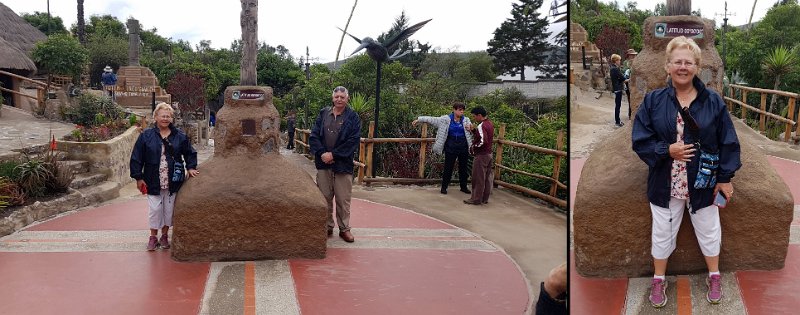 he world - latitude 00 degrees 00"00''. This is where the
country Ecuador gets its name - because the equator runs through it (even though
the equator runs through other countries also). Just a short distance away, was
the Ethnographic Museum, which shows the diversity of
Ecuador's native
groups. Here we learned how the natives shrunk the heads of their enemies. Today
they still carry on the tradition but they use monkeys' heads. At the entrance
to the museum were 2 llamas in pens, one appeared to be smaller, and probably
the baby of the other. They allowed you to pat them through the fence.
he world - latitude 00 degrees 00"00''. This is where the
country Ecuador gets its name - because the equator runs through it (even though
the equator runs through other countries also). Just a short distance away, was
the Ethnographic Museum, which shows the diversity of
Ecuador's native
groups. Here we learned how the natives shrunk the heads of their enemies. Today
they still carry on the tradition but they use monkeys' heads. At the entrance
to the museum were 2 llamas in pens, one appeared to be smaller, and probably
the baby of the other. They allowed you to pat them through the fence.
At the museum our guide
showed us several tests to show how things behave differently on the equator,
the northern hemisphere or the southern hemisphere eg. how the water goes down
the drain clockwise in the southern hemisphere (like in Australia) and
anti-clockwise in the northern hemisphere (like in the UK). AND - you only had
to be over the equator line by a few feet to make the difference - amazing! We
could get our passports stamped with this '0' latitude proof.
16-1-2018 Tuesday
Cotapaxi National Park
It was still raining this
morning but less and less as we got out of Quito. Jorge picked us up at 8am and
drove to Cotapaxi National Park to view Cotapaxi volcano (5,943 metres),
the highest active volcano in the world. We firstly visited the museum in the
national park to get an idea of the volcano and its surrounds. It was a bit cold
but not too bad. Driving a bit further to Limpiopungo Lagoon we walked
around the lagoon taking us up to about 3800 metres. Over 2461 metres (8000
feet) is the threshold for the beginnings of altitude sickness, brought on
because the air doesn't contain as much oxygen as we are used to, and therefore
can make us sick if we don't take it easy.
Mountain climbers have to
be particularly careful of this as they tend to ascend to a much greater height
and at a much faster rate than we do, with our touristy walking. People have
died because they have not allowed enough time to get used to the less
oxygenated air, and haven't heeded the warning signs and descended when they
started getting serious symptoms. We walked slowly and concentrated on
increasing our breath depth and frequency. At times we felt a bit funny in the
head but we were ok. In the distance we could see Cotapaxi volcano mostly
covered with cloud but occasionally we could see the snow caps. Northeast lies
Rumiñahui (4,557 m) and between the two mountains the plain and Limpiopungo
Lagoon. The surrounding scenery also includes volcanoes like Pasochoa, Ruminahui
and Sincholagua.
Despite the altitude, the
Park is home to numerous birds and varied plant life. There were many birds out
on the lagoon. Jorge showed us the Valerian plant which grows well as this
altitude - Valerian is used to help with sleep problems. The plant is also used
to make valium when mixed with some other chemicals. We had a nice lunch at a
hacienda called Hosteria La Cienesa, with a long driveway, lovely gardens
and big white posts out the front that put me in mind of Tara, the house out of
the book/movie "Gone With The Wind" with Clark Gable and Vivian Leigh.
On the way back we visited
a roses growing business, called Rose Success. There were many
greenhouses growing all colours of beautiful roses and we were able to walk
through the greenhouse and take photos. They export 30,000 roses per day! many
of them to Russia. They didn't seem to
have any fragrance at all which was quite disappointing for such a beautiful
flower, as I have been used to growing up with beautiful smelling roses that my
Mum used to grow in her garden.
We went right through the
processing place where they wash, grade, sort by height, length of stem, size of
the rose and how open it is before it is packed into boxes of 12. If the rose is
too open it is rejected for the export market and kept for the home market -
sounds a bit like Australia where the best meat and seafood gets exported and
the lesser quality is sold to us. I think my Mum would've loved to wander
through this place. As we drove back closer to Quito and our hotel the rain got
heavier as it was when we left this morning. Traffic was crazy and they drive
quite aggressively, forcing their way into a line/merge. I'm glad I wasn't
driving.
17-1-2018 Wednesday
Peru is a country in South America that's home to a section of Amazon
rainforest and Machu Picchu, an ancient Incan city high in the Andes mountains.
The region around Machu Picchu, including the Sacred Valley, Inca Trail and
colonial city of Cusco, is rich in archaeological sites. On Peru’s arid
Pacific coast is Lima, the capital, with a preserved colonial centre and
important collections of pre-Columbian art.
Lima founded in 1535, the capital of Peru, lies on the
country's arid Pacific coast. Though its colonial centre is preserved, it's a
bustling metropolis and one of South America’s largest cities. It's home to
the Museo Larco collection of pre-Columbian art and the Museo de la Nación,
tracing the history of Peru’s ancient civilizations. The Plaza de Armas and
the 16th-century cathedral are the heart of old Lima Centro. Lima
is known as the “gastronomical capital of the Americas”, encompassing
specialties from ceviche and traditional coastal cooking to refined global fare.
It even boasts several of the top restaurants in the world.
This morning we started our
course of the drug Diamox which our Dr prescribed as a precaution against
altitude sickness. We are taking it 2 days prior to reaching the city of
altitude and taking it for 3 more days after arriving at said place. It is
supposed to make the blood slightly acidic which will then encourage the body to
breathe more frequently to balance out the oxygen deficiency. We trialled it at
home for 2 days before our trip, to see if there were any bad side effects.
Luckily we only just felt like we had a bit of a hangover.
We checked out of the
Hilton at 12.00, leaving our bags at the hotel storage while we walked around
the town of Quito and filled in the time until our transfer to the airport at
4pm. We were very happy with the Hilton and they included bottled water (as
we've been told to only drink bottled water in South America). Other hotels
since then have all charged extra for the water. I don't like having to guage
how much water we'll be using, because I have to buy it and don't want to waste
it, and don't want to be caught short. We so much take it for granted at home
that we can just turn on the tap whenever we want.
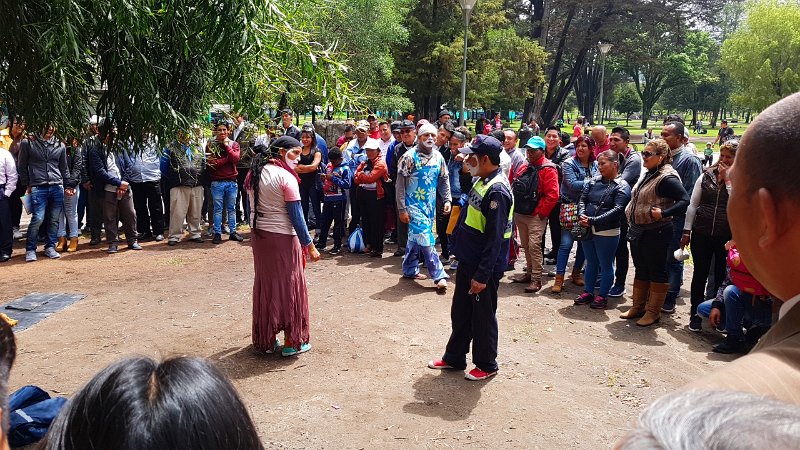 We walked across the road
from the hotel to the park. There were market stalls set up with much colourful
merchandise. There was a crowd gathered around a group of 3 people who were
putting on a comical show - one dressed as a policeman and the other 2 as
supposed criminals, all with painted faces. They were speaking Spanish so we
couldn't understand but they were making the crowd laugh with what they were
saying, seemingly back chatting and making a fool out of the one dressed as a
policeman.
We walked across the road
from the hotel to the park. There were market stalls set up with much colourful
merchandise. There was a crowd gathered around a group of 3 people who were
putting on a comical show - one dressed as a policeman and the other 2 as
supposed criminals, all with painted faces. They were speaking Spanish so we
couldn't understand but they were making the crowd laugh with what they were
saying, seemingly back chatting and making a fool out of the one dressed as a
policeman.
Our flight 8pm flight got
us into Lima (capital of Peru) at about 10.30pm and our transport was
there to take us to the Casa Republica Hotel for 2 nights. The roads were
unusually very busy at that time of night as the Pope is arriving tomorrow and
some streets have been block off.
18-1-2018 (Thursday)
We had a welcome sleep in
after our late arrival last night. After breakfast at the hotel we went for a
walk. It is a lovely place, close to the ocean. Our hotel appears to be a
renovated old house with high ceilings, and circular wooden stairs to our upper
floor - no lift. Our bathroom, with a separate bath to the shower, was as big as
our bedroom. Outside our door there is an atrium down through the middle of the
floor to reception.
We were really happy about
our tour being scheduled for 2pm - Lima City Tour
- the Colonial ‘City of Kings’. We visited the Cathedral (not
photos allowed), the Presidential
Palace, the Plaza de Armas
(which was closed off for preparation for a party tonight for the birthday of
Lima). We stopped at an archaelogical historic site Huaca Pucllana which
we could only see from the outside as restoration work was going on. Men were
restoring the outside with mud bricks, laid vertically so they looked like books
on shelves - apparently this method made the building more resistant to
earthquake damage. This was a sacrificial place - of humans as well as animals.
Our next stop was the San
Francisco Convent. We looked through it first and then went down underneath
where the Catacombs were located. I was very pleased about this because 6
years ago when we were in France there was a 2 hour waiting time to get in to
see their Catacombs, so we didn't go. In colonial times it was normal for the
cemetery to be under the church so there are many graves here. We saw some
displays of skulls and long bones, and then there were many long bones laid out
in long boxes. It was very interesting. Our guide said these have been put here
as a display for visitors and he allowed us to take some photos. We walked to a
recommended nearby restaurant called Isolinas for nice dinner.
19-1-2018 Friday
Juliaca is a city in the San Román province of
southern Peru. A busy transit hub, it's a jumping-off point for Lake Titicaca,
the vast Andean lake marked by Inca ruins and floating villages. In the central
Plaza Bolognesi, vendors at the Galería Artesanal Las Calceteras market sell
handicrafts and wool products. Churches include Templo de la Merced on the plaza
and Iglesia Matriz de Santa Catalina to the northwest.
We were up at 5am for 6am
breakfast and a 6.30am transport to the airport. Originally our pick up time at
the hotel was to be 7.30am but because some of the roads are cut off to the
airport and traffic will be hectic due to the Pope's visit, they brought our
time forward 1 hour. Traffic close to the airport was crazy - even our driver
said so. At one point we saw a driver get out of a car and go over to another
car to vent - luckily no blows. This situation should've had policeman directing
traffic but there wasn't. The intersections were just all blocked with cars
inching forward as best they could to get through. We finally got there on time
but I wondered how many didn't. We were only doing a domestic flight from Lima
to Juliaca but in Peru you have to be at the airport for domestic flights 3
hours before, and international flights, 4 hours before. I won't complain about
our airport pre-flight times again. The plane was 1 hour late taking off so it
was a loooong morning!
On arriving at Juliaca
(Chile) our guide and transport were there to meet us, Romulo. Our ultimate
destination today was Puno, which is about 1 hour away, so we
saw some things on the way. 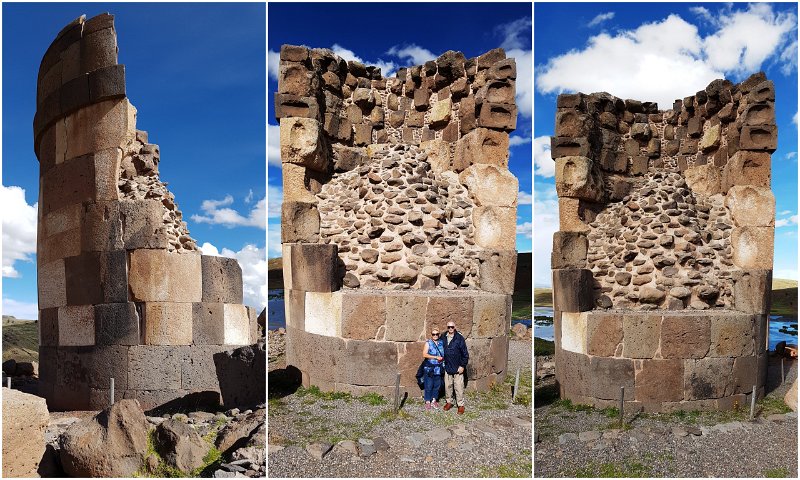 Firstly we visited the pre-Inca burial ground of Sillustani.
Here we wandered through the remarkable tombs built from volcanic stone. Known
as Chullpas, these funerary towers reach heights of up to 12 metres.
Overlooking the beautiful Lake Umayo, Sillustani is considered to be one
of the most important necropolises in the world. The Chullpas are up a steep
path and Juliaca is already at a height of 3825 metres, 1400 metres higher than
the level where altitude sickness can start to affect us. We have been taking
the Diamox for 2 days so were fairly ok, except for a noticeable need to breath
more frequently and just take it easy, going up the path in short bursts.
Firstly we visited the pre-Inca burial ground of Sillustani.
Here we wandered through the remarkable tombs built from volcanic stone. Known
as Chullpas, these funerary towers reach heights of up to 12 metres.
Overlooking the beautiful Lake Umayo, Sillustani is considered to be one
of the most important necropolises in the world. The Chullpas are up a steep
path and Juliaca is already at a height of 3825 metres, 1400 metres higher than
the level where altitude sickness can start to affect us. We have been taking
the Diamox for 2 days so were fairly ok, except for a noticeable need to breath
more frequently and just take it easy, going up the path in short bursts.
There are houses dotted
around with their animals - llamas, alpacas, sheep, beef, pigs and birds. Our
guide was very knowledgeable about this area and the scenery was breathtaking.
We then drove about 45 mins to the city of Puno (Peru) and the Casa
Andina Hotel for 2 nights. After getting squared away in our room we went
for dinner to a place close to the hotel before getting to bed as soon as
possible - it'd been a long day and we had another early start tomorrow.
20-1-2018 Saturday
Puno lies on the
shores of Lake Titicaca, one of South America's largest
lakes and the highest navigable lake in the world. It is the largest city in the
Southern Altiplano and an important agricultural and livestock (llamas and
alpaca) region. It sits at an altitude of over 3,800 metres and is a picturesque
hillside city and a melting pot of the Aymara and Quechua culture. A
regional trading hub, the city's also considered Peru's "folkloric
capital" owing to its traditional festivals featuring vibrant music and
dancing. Landmarks include the Andean baroque-style Puno Cathedral and the
Yavari, a 19th-century steamship (now a bed and breakfast).
This morning we got up at
5am to get ready, have breakfast and be ready for our 6.45am pick up ride to the
boat harbour. Today we board a speedboat for a comfortable 35 min ride to a
remote area of the National Reserve of Lake Titicaca, to visit the Uros
floating islands. These are considered to be the last authentic floating
islands, less commercial and little visited, although I am a little unconvinced
of this because they have laid out on small tables, souvenirs made out wood,
decoratively painted, and necklaces, made out of porcelain, ceramic, beads, and
shells, ready to sell to tourists. The ladies also do colourful tapestries depicting
their way of life, which we really liked so bought one.
We were told that their
main way of living was from the sea, fish, etc, but this is a dwindling source
due to other reasons such as commercial fishing, so tourism is a natural income
alternative. The men and women here wear the traditional clothes, especially the
ladies with their colourful outfits and always hats. Some places they wear
bowler hats like the English gentleman used to in the 1800/early 1900s. We were
told when some visiting Englishmen came to this country that long ago, the trend
was adopted by the ladies, not the men, and they still wear them today.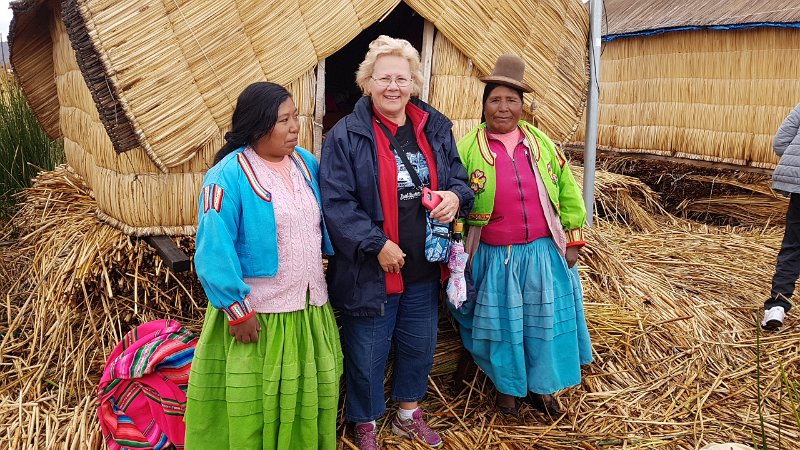
The Uros are descendants of
one of the oldest cultures in South America. These people live on floating
islands that they have made, using cut reeds that have been growing in the
water. They cut big blocks of the material that the reeds grow in under the
water - they reminded me of peat that they cut out of the ground in the UK to
dry and use as fuel. These blocks have the roots growing all through them which
binds them together but they are light, and so float, even with all the living
stuff, like houses, people, etc, that are going to be put on top of them
eventually. They had 4 of these blocks ready to demonstrate to us how they
hammer bits of wood in so they can tie them together, and then they become an
island and float. Then they cut the green reeds and layer them over the top of
these blocks, criss crossing layers as they go, until they get a floor that can
be walked on and built on, without getting wet.
In some places we noticed
water was seeping up as we walked on it, but as the cut reeds get older and
deteriorate, they just cut more and put them on top. It was like walking on a
water bed but we are assured it's very safe. This process actually takes a
while, not sure if weeks or months, before the floating island is ready to live
on. They build their little houses out of the reed material, and woven fancy
parasol type umbrellas sit outside their houses for shade.
They build and weave many
things out of the thick green reeds, canoes, and even big sturdy reed boats,
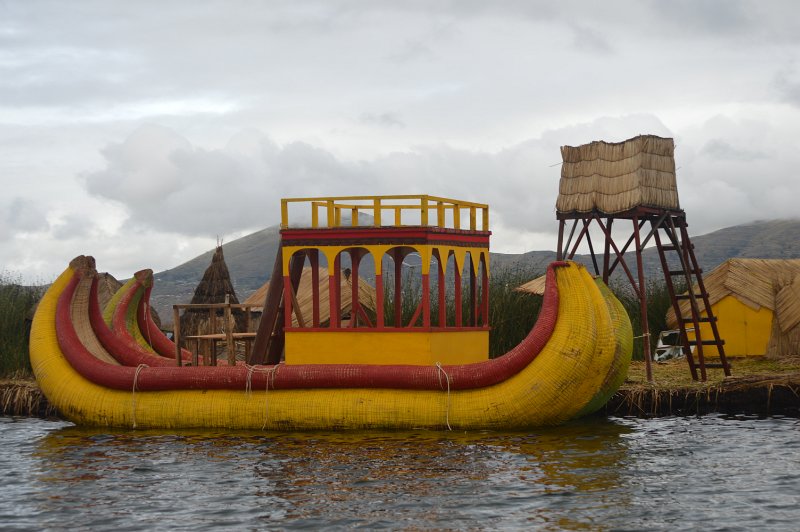 the shape of which reminds me of the viking boats, but with two figureheads,
mostly shape of cat heads. We went for a ride in one of these. They are big and
hold about 6-8 people, and even had an upper deck which we climbed up to (on a
rickety, makeshift ladder) to get a better view as two of the guys rowed. Funny
- this boat didn't have a motor, just people power, as you'd expect, but we did
see one boat that did have a small motor on it (killed the illusion) - oh well,
technology has to catch up sooner or later. They also use the reeds as a source
of food - they just pick a fresh one up, peel it and eat it - I did try it but
it didn't taste like much to me but would probably be very healthy. It wasn't
really said if they cook it to eat but probably do.
the shape of which reminds me of the viking boats, but with two figureheads,
mostly shape of cat heads. We went for a ride in one of these. They are big and
hold about 6-8 people, and even had an upper deck which we climbed up to (on a
rickety, makeshift ladder) to get a better view as two of the guys rowed. Funny
- this boat didn't have a motor, just people power, as you'd expect, but we did
see one boat that did have a small motor on it (killed the illusion) - oh well,
technology has to catch up sooner or later. They also use the reeds as a source
of food - they just pick a fresh one up, peel it and eat it - I did try it but
it didn't taste like much to me but would probably be very healthy. It wasn't
really said if they cook it to eat but probably do.
Next we hopped back into
the speed boat and headed to Taquile Island which took about 1 and a half
hours. Lake Titicaca is enormous and part of it is inside the border of the
country of Bolivia. Disembarking at a secluded part of the island, we explore a
scenic and less touristy area of Taquile Island (exclusive). It was a steep walk
up on a concrete path with steps, from the boat to a junction. We, and most of
the people, had to stop several times, to rest and catch our breath, as we are
still in the 3800 metre altitude. Lots of villages on this island grow crops on
centuries' old terraces and sheep grazing in areas fenced by rock walls. At the
junction those who felt a bit more adventurous, could go with the guide along a
pre-Inca trail with spectacular landscapes of the island. Those of us who
weren't adventurous, ie. Dave, another lady and myself, made our way along a
more level path to our destination.
21-1-2018 (Sunday
- Bus: Puno - Cusco
Cusco, set at an altitude of 3,400 metres, in the Peruvian Andes, was once
capital of the Inca Empire, and is now known for its Incan remains and Spanish
colonial architecture. Plaza de Armas is the central square in the old city,
with arcades, carved wooden balconies and Incan wall ruins. The baroque Santo
Domingo Convent was built on top of the Incan Temple of the Sun (Qoricancha),
and has archaeological remains of Inca stonework. Many of the colonial
buildings were built on top of Incan foundations and the stonework is
unparalleled in its precision and beauty.
When we were at home, looking at our itinerary and we saw this bus ride that was
going to take 10 hours, we were a bit horrified and were dreading it, but it
turned out to be quite good. The bus was very comfortable, plenty of empty seats
so could spread out and it was also a nice change after having so many flights,
most of which involved a lot of waiting around time.
We were up at 5am, breakfast and be ready for our 6.20am pick up and transfer to
the bus station for a 10 hour bus ride to Cusco. We didn't have to wait long
before boarding our bus. Our guide Enrique, was very good (as all our guides
have been so far), very animated and told his stories with interest and energy,
and made you eager to hear more.
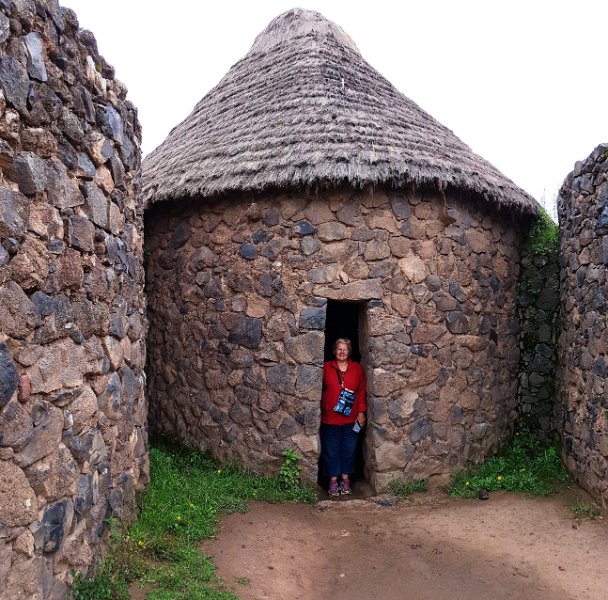
The spectacular journey from Puno (Peru) to Cusco (Peru) took us across the
Altiplano and through sleepy Andean villages and past spectacular snowcapped
mountains. The Andes mountains were omnipresent, no matter where or what days we
travelled. We travelled through the towns of Pucara and Andahuaylillas
and the pre-Inca ruin of Raqchi.
We had a nice buffet lunch at Andahuaylillas. In one town we were in time to
experience a religious procession with music, come up the street and up the
church steps that we just happened to be standing on. About 4-6 men carried some
sort of wooden item covered with greenery and flowers, like the chair they
carried the Chinese Emperor around in. Enrique said this procession was very
unusual as it was a Catholic Church and an Indian (people from India) ceremony
combined into one, which you wouldn't see anywhere else.
In Peru alpaca is a common food, but guinea pig is only eaten on special
occasions as it's expensive. Driving in the bus through one town, a couple
ladies came out to the road to hold up in the air for us to see, and try to
sell, their cooked guinea pigs, on a stick, with the head still on! They are
found in the wild and also kept domestically for food. These guinea pigs are
larger than the ones we have at home for pets.
When we finally arrived in Cusco (Peru) our transfer driver was there to
take us to the Casa Andina Plaza Hotel for 2 nights.
22-1-2018 Monday
Slept in til
8.15am which was nice for a change. Had breakfast and went for a walk around the
city of Cusco. We noticed that it was clean and felt very
safe. We walked to the San Pedro Markets - Wow! what a big place and so
interesting. Everything is sold here from souvenirs and clothes, fresh fruit and
vegetables, to freshly butchered meat! We were gobsmacked when in the corner of
the market, under the same roof as everything else and not far from the
eateries, there was basically a butcher shop, not walled off in any way from the
rest of the market. At the beginning of the fresh meat row were big striped
bags, full to the top with the unsaleable rubbish offcuts, including horns
(although I'm sure these would be cleaned, polished and sold off somewhere as
souvenirs).
Walking down
this aisle we saw on the bench, cow's heads, bowls of offal like liver and
kidneys, bowls of particular bone pieces like for soups, intestines (maybe to
use the casings for sausages?), pigs trotters, fine lower legs with pinky
coloured hooves of what appeared to have belonged probably to llamas or alpacas,
even long tails stripped of the hide, and hanging on hooks from a line, whole
tongues and other items. We didn't actually see too many trays of just joints
for roasts and meat pieces so not sure if they'd already been taken/sold or this
was just the odds and ends shop(?) They had to shoo away the stray dogs that'd
come in attracted by the raw meat aroma. We did see pork and beef meat for sale
in other stalls in the market.
There was a
large number of interesting eateries, especially soup dishes - I was sorry we'd
already had breakfast. I bought a selection of packets of nuts, pepitas and
piqueos (roasted white corn niblets) for those times when we don't need dinner
but want something to nibble. This packet corn (piqueos) is crunchy and probably
very good fibre, but doesn't really have much taste, even roasted. I've had this
white corn freshly cooked - the nibblets are quite large compared to our sweet
yellow corn but they're not sweet and don't really have much taste to them.
We're told Peru has many varieties of corn including a purple one that is used a
lot in making drinks and desserts, but this white one seems to be the most
common one we've seen, especially with cooked meals (and not seen the yellow
sweet one at all).
We walked to
the big square, Plaza de Armas, with a statue and fountain, and lovely
arranged flower beds (every town seems to have a Plaza de Armas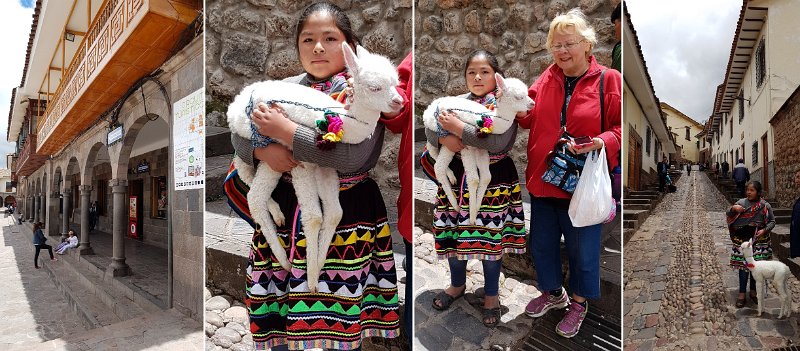 - so probably
just a general name like a city or central square). Had a photo take with a
little girl and her baby white llama. In the early afternoon we went on
our booked sightseeing bus tour through Cusco, the heart of the Inca Empire -
the Cusco City Tour with our tour guide Jose. We visited the very ornate La
Catedral, built on the ruins of an Inca Palace; Qorikancha Temple of
the Sun; and the 12-Angled rock - the stone of the 12 angles (not sure of
the significance of this stone) is located in Hatun Rumiyoq St and is part of a
wall of the Inka Roka's house (one of the major leaders of the Inca Empire).
- so probably
just a general name like a city or central square). Had a photo take with a
little girl and her baby white llama. In the early afternoon we went on
our booked sightseeing bus tour through Cusco, the heart of the Inca Empire -
the Cusco City Tour with our tour guide Jose. We visited the very ornate La
Catedral, built on the ruins of an Inca Palace; Qorikancha Temple of
the Sun; and the 12-Angled rock - the stone of the 12 angles (not sure of
the significance of this stone) is located in Hatun Rumiyoq St and is part of a
wall of the Inka Roka's house (one of the major leaders of the Inca Empire).
The Incas
built their walls and buildings with big blocks of stone, putting them together,
honing the sides and corners with such precision that they fitted together
perfectly like a jigsaw, and without the benefit of mortar or similar substance
to help 'glue' them together. How they moved these blocks at all, let alone
moving them back and forth several times to shape and smooth them to ensure they
fitted together perfectly, is mind boggling. The walls were always on a slant
which at first looked like bad workmanship until we were told that this gave
strength to the wall, and resistance to earthquakes. Windows and doorways did
not have squared corners, they were shorter across the top and longer across the
bottom, also giving strength and resistance to earthquakes. When earthquakes
occurred in Peru, post-inca buildings fell down but the age old inca
walls/buildings did not.
From here we
headed to the archaeological remains located around the city, including the
impressive fortress of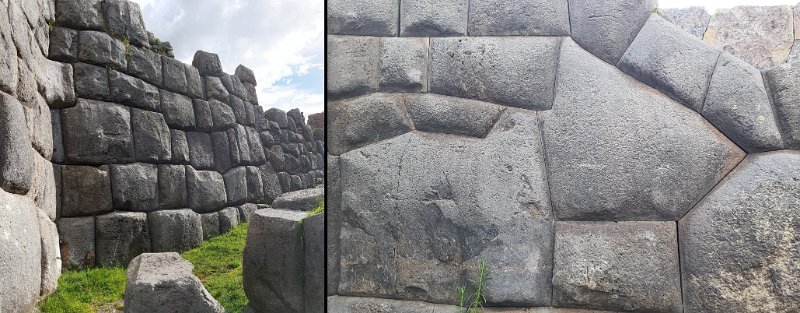 Sacsayhuaman, with open beautiful green areas,
terraced hills and the incan walls with the giant blocks of rocks, again
perfectly shaped to fit one another. Q'enqo the giant rock which was
inside a dark cave and we used our mobile phone lights to see but as space was
limited we didn't get the full picture from the guide as to what this was about.
Finally the Water Temple of Tambomachay which was a 10 min walk up some
hill to see some view but we'd had enough of climbing hills and steps for one
day so didn't do this.
Sacsayhuaman, with open beautiful green areas,
terraced hills and the incan walls with the giant blocks of rocks, again
perfectly shaped to fit one another. Q'enqo the giant rock which was
inside a dark cave and we used our mobile phone lights to see but as space was
limited we didn't get the full picture from the guide as to what this was about.
Finally the Water Temple of Tambomachay which was a 10 min walk up some
hill to see some view but we'd had enough of climbing hills and steps for one
day so didn't do this.
Someone had
asked one of the guides why Cusco didn't remain the capital of Peru and he
replied that it was due to the altitude. The conquering Spanish weren't used to
this altitude and suffered because of it, so Lima was made the capital instead.
There was also a similar problem with the crops and cattle which had to be
adapted. The Swisse Brown cattle (I think they have a very distinctive, nice
look about them) were brought in, assumably from Switzerland, as they were
already used to a high altitude.
It was about
6.10pm when we arrived back so we went to Paddy's Irish Pub for dinner.
We were surprised to see this establishment in Cusco. Apparently and Irishman
met and married a Peruvian lady and they set up this pub. It was small but
quaint and full of memorabilia like Singer treddle sewing machines converted to
tables and old news items and comical sayings on the walls. A small train set,
with beer cans on the carriage, ran around the room on a track set up close to
the ceiling.
23-1-2018
Tuesday Sacred Valley Tour & Aguas Calientes
The Sacred Valley of the Incas is a region in Peru's
Andean highlands. This fertile valley was home to many important sites for the
Incas, both strategic and religious. Along with the nearby town of Cusco and the
ancient city of Machu Picchu, it formed the heart of the Inca Empire. Along the
way we visit Spanish colonial villages like Pisac and Ollantaytambo. Pisac is
known for its Sunday handicraft market and hilltop Incan citadel.
This morning we were up at 5.30am to pack up, breakfast and ready for a long
day. As we were going to Machu Picchu this afternoon for the night, we had to
pack our small trundle bags for overnight, check out of our room and put our big
bags into the hotel storage for the night. Our trundle bags weren't to be over
5ks as there was limited space on the train. At 7.30am we departed on our bus
trip for the Sacred Valley tour.
Our guide for the Sacred Valley today, Pumasonga, told us he speaks Quechua
(pronounced 'ketchua') as well as Spanish, English and French (which was handy
for one of our group who was French Canadian and didn't have a lot of English). Quechua
is the same language used by the Incas, which is why I thought it relevant
to include this information in the diary for today (found this info in the Machu
Picchu book Dave bought). "It is still spoken in the Andes. Its original
name is Runa Simi (language of mankind). Despite the efforts of Andean
governments to eradicate this language, fortunately it still survives. Currently
there are millions of people who use Quechua. This language is known and spoken
in several regions of the Andes and in most of the South American
countries."
(A note about our guide Pumasonga - he was a small, lively, likable man who
often said "ladies and a gentlemans" to address us. Every time he said
it, he reminded us of one of our loveable Australian comedians, Mark Mitchell,
who did a regular comic skit in a comedy show each week in the 1980s-90s as Con
The (Greek) Fruiteror. As Con, he often prefaced his statements with "now
ladies and a gentlemans". So every time Pumasonga said "ladies and a
gentlemans" we couldn't stop a smile crossing our faces. I think we really
enjoyed our day more because of this actually.)
The first
stop is the spectacular Pisac Ruins - a hilltop Inca citadel and fortress
with impressive agricultural terracing. This area is an archaelogical site so
not used anymore for agricultural purposes. We climbed up these ruins too, steep
steps at times, really giving the knees a workout. Our guide told us that some
of the terracing there was not used for agriculture, but constructed because the
terrain was very steep, to prevent erosion when the severe rains came.
Then we went
back to the village of Pisac where Pumasonga took us in to a silver jewellery
shop. The lady told us how they combine the silver with another metal to make
silver jewellery more workable. Here I was informed (as I asked) that the silver
'sun and moon' earrings I was wearing and bought in the Cusco square were fakes,
even though they had the '950' stamp on the back. Apparently silver doesn't go
dull and these did. I didn't pay a lot for them really and did like them so
wasn't too unhappy. To get them in silver would cost over 4 times what I paid
and wasn't going to pay that. Then we went to the local Pisac markets. On
market days Pisac comes alive with locals from nearby hillside villages, in
traditional dress selling local fruit and vegetables as well as handicrafts.
We had some
free time to wander through the colourful market stalls. Dave and I, instead of
walking around the markets, walked down to the river and the bridge for photos.
We've seen many, many of these little taxis all over South America which are
really motorbikes with a built around cabin and 2 wheels at the back (can't
remember the name but similar to tuk tuks in Thailand). They don't look
comfortable. After that we got back on to the bus and drove to the town of Yucay
and a local restaurant for a typical Andean very nice lunch.
Ollantaytambo is a village in the Sacred Valley of south Peru, set on the
Urubamba River amid snow-capped mountains. It's known for the Ollantaytambo
ruins, a massive Inca fortress with large stone terraces on a hillside. Major
sites within the complex include the huge Sun Temple and the Princess Baths
fountain. The village's old town is an Inca-era grid of cobblestone streets and
adobe buildings.
After lunch
we continued our journey along the River Urubamba, to Ollantaytambo.
The town, which is dominated by a giant Inca fortress, is perhaps the
best surviving example of Inca town planning and was the scene of a rare Inca
victory over the invading Spanish. At the bottom of the climb was a big grassy
area and llamas were
grazing. A mother and younger one were particularly cute
and we were quite close to them. The climb up was mostly big stone steps most of
the way, and there were many of them - it was quite daunting. We were encouraged
by Pumasonga to take rest breaks, take full breaths, and to continue to the top.
We could go off the steps to the side onto the grassed terraces to catch our
breath and recover while he talked more to the group. The place was very busy.
When we stopped and rested we actually recovered fairly quickly, ready for the
next onslaught. He told us Machu Picchu was not as hard as this climb which was
encouraging, and that we could do this one without a problem, if we just take it
easy.
At the end of
this tour the bus stopped at the train station in Ollantaytambo. Some of the
group were going back to Cusco today, some were staying at a hotel here and
going to Machu Picchu tomorrow, but we were catching the train today to the
village of Aguas Calientes for the night. The tour blurb said we travel on a
"comfortable and well-appointed Inca Rail train, a superior tourist
class train" but we didn't think so, especially when we took the train back
the next day, and experienced a much more superior ride. Our ride today didn't
seem to have as much leg room, the seats weren't as nice or comfortable, the
aisle was smaller, the carriage rocked from side to side constantly, and the
driver seemed to sit on the horn quite regularly and it felt like we were in the
same carriage as the driver. The snack we got wasn't even as good as the one we
got on the train going back. Our train took 1 hr and 40 mins to get to Aguas
Calientes (Peru) where we were met and taken to the Casa Andina MAPI
(Machu Picchu) Hotel for 1 night.
Our hotel
wasn't far away from the train station thankfully, especially as it had been
raining. Our room was right beside the rushing and powerful Urubamba River
and we could hear it slightly with the window shut. We opened the window and it
was quite loud and a fantastic sight to see right outside your hotel window. It
had been a very long and tiring day and we were both beat, so we went to bed
early.
24-1-2018
Wednesday Machu Picchu Guided Tour
Machu Picchu is an Incan citadel set high in the
Andes Mountains in Peru, above the Urubamba River valley. It is located
2,430 metres above sea level on a mountain ridge above the Sacred Valley. Built
in the 15th century and later abandoned, it’s renowned for its sophisticated
dry-stone walls that fuse huge blocks without the use of mortar, intriguing
buildings that play on astronomical alignments and panoramic views. Its exact
former use remains a mystery.
It is
the most famous of all Inca sites, but it was not until 1911 that it was brought
to the world’s attention by the American historian Hiram Bingham. The Incas
abandoned the city just prior to Spanish colonisation, the city was never
pillaged and as a result the ruins are still in fantastic condition. With its
location on a dramatic ridgeline surrounded by sheer cliffs and the Urubamba
River on three sides, the city of Machu Picchu is a remarkable place to visit.
Machu Picchu was declared a UNESCO World Heritage Site in 1983 and in 2007 it
was voted one of the new Seven Wonders of the World.
Up at 5.40am,
breakfast and met our guide, Wilfredo, at 7.40am. We had packed our small
trundle bags and checked out of our room as we'd be catching the train back
after our tour. To get up to the Machu Picchu site we had to board a bus and
take a 30 min winding, rocky, rough road up the hill from Aguas Calientes. After
finally getting in to the site, our very knowledgeable guide Wilfredo, spent
about 4 hours taking us, and 2 other nice people from the U.S., around, as well
as taking some very good photos for us. After all his tours he knows just the
right places and poses for the best photos. He took one of us with the famous
and well known site in the background, and you could forgive people for thinking
it'd been photo-shopped - I had to look at it twice.
What an
honour and pleasure it is to be here, in this remarkable, historic, and wondrous
site! It was hard not to keep taking more and more photos, of all different
directions and angles, knowing full well you'd have to sort through them later
and cull many. I am happy to say that after all the walking and hard climbing we
had done in Ollyantambo and other places on this trip, we found Machu Picchu
fairly easy. For anyone who hadn't done any of this sort of climbing recently,
they may have found it hard. There were a few people we saw who were really
perspiring and breathing hard. We were very lucky also with the weather as it is
the rainy season here. It was nice and sunny, great for photos but the afternoon
tour people weren't going to have such a good view as it clouded over later.
Wilfredo said that because the site is up so high, any cloud covers the 'famous
picture' and ruins it - we're so glad we had the morning tour.
The names of
the ruins and monuments were the Main Square, the Circular Tower,
the Sacred Solar Clock, the Royal Quarters, the Temple of the Three
Windows and the Cemeteries. Here, as in other places we've been (in
Peru and Stonehenge in the UK), were important places/temples constructed
specifically for the winter solstice alignment. The sun was an important part of
the Incas' life - it was their God. Many ceremonies were carried out in the name
of 'Pachamama' which means earth mother or mother nature. Sacrificial
offerings were made of products of the land such as fruit and vegetables, and
also animals. At one time there was even human sacrifice to appease the Gods.
These traditions are still carried on today in honour of Pachamama (although
probably not humans or animals anymore). They have a symbol for Pachamama, which
commonly features in jewellery.
Again we saw
the wonder of how the Incas built these places, with such large stones, how they
transported and shaped them, to fit perfectly like a jigsaw with others, and
without any mortar. It's also still a wonder how they split the rocks as they
did not have to necessary tools. A further climb and entry permit is needed for
Huayna Picchu (the iconic hill behind the Machu Picchu ruins). To do this one
you need to pre-book your permit with at least 3 months in advance - we didn't
want to do this as we heard it was quite a bit more difficult and weren't that
adventurous. Toward the end of our tour we had the pleasure of being up close to
several llamas
After our
tour of Machu Picchu, Wilfredo led us back to where we could get our passports
stamped with the MP stamp, and the place to catch the bus back down to the town.
He waited for his next tour. Back in Aguas Calientes we had some lunch and
wandered around the markets to look for souvenirs. Later that afternoon we
hopped on the 4.20pm train for a 1 hour 30 min journey on the much more
comfortable Vistadome train, to Ollantaytambo.
After we had
our snack and drink on the train, stewards put on a fashion show up and down the
aisle. They were modeling beautiful clothes made from baby Alpaca wool and they
were gorgeous to look at and very soft to touch. The man of the Canadian couple
we were sitting with, was wearing a lovely baby alpaca cardigan he'd bought. He
said he was told there were 3 types of alpaca garments - adult alpaca, baby
alpaca and 'maybe' alpaca! Ha ha! So obviously, of course, fakes are made of
these clothes just like the 'silver' jewelry I bought.
At the
station we were picked up in a private car and transported for another hour and
30min back to Cusco (Peru) and the same Casa Andina Plaza Hotel
for 2 nights. It was about 7.45pm, dark and good to get into our room after such
a long day, especially as the driver we had seemed very much in a hurry to get
to our destination. The hotel staff were very efficient at getting our big bags
out of storage for us so there was, thankfully, no hold up there. We have
another early start tomorrow so quickly off to bed.
25-1-2018
Thursday Q'eswachaka: Inca Rope Bridge Tour
Qeshuachaka a rope of twisted dried maguey or
ichu, chaka bridge, consisting of ropes made of grass and spanning the Apurimac
River near Huinchiri, in Quehue District, Canas Province, Peru, is the last
remaining Inca rope bridge.
Even though there is a modern bridge nearby, the residents of the region
keep the ancient tradition and skills alive by renewing the bridge annually, in
June. Several family groups have each prepared a number of grass-ropes to be
formed into cables at the site, others prepare mats for decking, and the
reconstruction is a communal effort. In ancient times the effort would have been
a form of tax, with participants coerced to perform the rebuilding; nowadays the
builders have indicated that effort is performed to honour their ancestors and
the Pachamama (Earth Mother).
We were up at
5.30am this morning, had breakfast and ready for our 7am pick up to drive 3
hours to see the Q'eswachaka Inca Rope Bridge (pronounced 'keswachaka').
It was an expensive tour due to the distance and we had a Chimu Adventures
employee (Larry) do the driving and a guide called Andy - so it was the expense
of 2 people and a car for a full day plus lunch. We had wondered if it was going
to be worth it - at the end of the day we agreed that it was. Once we got out of
the city it was easy driving and the scenery was nice, quite green land. Some of
the roads leave a lot to be desired with big holes and that's something we've
noticed regularly when driving all over Peru on our tours.
We stopped at
one place, with not much housing or development around, and Andy pointed out
this conical shape a few metres off the road in a field, about 8 metres (25
feet) high, which looked like a big cow manure heap. It was an inactive
volcano. It also had the appearance to me of Jabba The Hut, the bit
slug-like character out of the Star Wars movie. Apparently a long time ago it
erupted slowly making the shape typical of a volcano (even though it's quite
small in terms of volcanoes), and then just went inactive - strange.
Along the way
we mentioned that it'd be nice to have a toilet break but it wasn't urgent yet.
Finally we pulled off the road in the middle of nowhere, not much around except
a small house in the distance, and it was indicated to go over behind a small
rise and do our business. I was quite surprised but then accepted that this was
all that was available to us out here. A few metres off the road, Dave held my
coat up in front of me to shield me. Luckily I was just finishing and hurriedly
rearranging clothes, when I heard the sound of a motorbike driving quite close,
and I'm sure there was a smile on the faces of the mature man and lady on the
bike as it drove past, knowing what we were doing.
Finally we
arrived at the Apurimac river where the Q'eswachaka Inca Rope bridge is
located. We drove across the modern bridge that was built to solve the river
crossing problem. It was a long way down to the river below. This Inca
suspension bridge is made of puna Straw called ichu. It is only a
pedestrian bridge although back in Inca times, they took fully laden llamas
across it. Every year four comunities come together for the mantenience and
renewal of the bridge. Before making the renovation process the local people
carry out a ceremony giving thanks and asking permission and giving thanks to
the Pachamama (mother earth). Andy told us that women help with this task too,
equally doing the work, not doing what's normally expected of women like
cooking.
We were very
impressed by the whole bridge, and especially the strength, thickness and woven
quality of the rope that especially anchors the bridge to the concrete ends on
each side - this rope looks like industrial quality and Andy told us it has the
strength to pull 3 ton. After quite a few photos and waiting for some other
people to cross the bridge, we took it in turns to walk to the middle of the
bridge for photos. It was high up and you could get a good sway up if you
weren't careful. The bottom of the bridge which you walk on, is lined with
sticks not the straw, but the rest of it is woven straw.
After we
finished crossing the bridge and taking photos, we sat and had the boxed lunch
we brought from the hotel this morning. Dave told Andy about another rope bridge
that he'd heard about from someone recently. Andy hadn't heard of it so while we
were driving he looked it up on his phone and we drove to it as it wasn't far
away. I think it was at a place called Checupa. This one wasn't as big or
impressive but it was interesting. You had to pay to walk on this one. Right
next to it was an impressive concrete and stone bridge built by the conquering
Spaniards.
We arrived
back at the hotel by mid afternoon which was good as we have another early start
tomorrow.
26 Jan
2018 Friday Travel Day
Another early
morning with being picked up at 6.40am and transferred to the airport for our
domestic flight to Lima (Peru) and then onward on an international flight to Santiago
(Chile) and the Providencia Hotel for 2 nights. This is the first
hotel we stayed at in South America, when we were on our way to the Galapagos
nearly 4 weeks ago - and, when our big bags didn't turn up after our flight and
we were without them for 2 days. We just about held our breath this time, until
thankfully, our bags came out on the carousel. As we flew into Chile we noticed
how the terrain got dryer and browner, unlike Peru and Ecuador.
We arrived at
3.30pm but Chile has a 2 hour time difference so was 5.30pm here. After being
picked up at the airport we had a nice relaxing trip to our hotel with a very
amiable driver, who didn't speak much English but we were able to communicate
and have a good laugh on the way anyway. After unpacking we had a nice dinner at
the hotel restaurant, which was good because we didn't really feel like going
out. This was the last of our 10 flights before going on our 22 day cruise on
Sunday. We are looking forward to no more flights, no packing and unpacking, and
going at a bit of a slower pace for a while.
27-1-2018
Saturday
Santiago, Chile’s capital and largest city, sits in a valley
surrounded by the snow-capped Andes and the Chilean Coast Range. Plaza de Armas,
the grand heart of the city’s old colonial core, is home to 2 neoclassical
landmarks: the 1808 Palacio de la Real Audiencia, housing the National History
Museum, and the 18th-century Metropolitan Cathedral. La Chascona is the
home-turned-museum of poet Pablo Neruda.
This morning
at 9am our guide Gabriel, picked us up for a half day Panoramic City Tour of
Santiago with another American couple. We visited the Plaza de Armas
(city's central square), the heart of the city's old colonial core; the 18th
century Metropolitan Cathedral; the early 19th century Royal Court
Palace that house the Natural History Museum and the Central Post
Office completed in 1882. We visited a racetrack with and saw some beautiful
racehorses being exercised, and then drove up Cerro Santa Lucia, the hill
on which Santiago was founded in 1541, now a park with fountains and stairs
leading to a fort and panoramic viewpoint across the city.
For a nice
dinner we walked down the corner to the restaurant Lomits, where we ate the
first time we were here.
28-1-2018 Sunday Embark
Antarctic Cruise
This morning
we checked out of the hotel at 8am and Gabriel, our driver and tour guide,
picked us up to drive us firstly, to the port city of Valparaiso
(Chile). Dave had been looking forward to going here, from where our cruise
ship was originally going to depart, as the city is known for its steep
funiculars - apparently the town has about 15 but only 8 or 9 are working.
Unfortunately at the last minute while we were still at home, they changed the
departure port to San Antonio so Dave organised a driver to take us to
Valparaiso first and then on to San Antonio. We got to ride on one of the
funiculars, called the Victoria, a short, steep ride up and then we
walked down. During the 19th century, an influx of European immigrants
left their mark on the city’s architecture and cultural institutions, many of
which congregate around downtown’s Plaza Sotomayor.
The city is
also known for its colourful, cliff top homes, hence the funiculars. There are
colourful and interesting murals everywhere, on building walls and fences, some
quite good, some quite abstract. Gabriel took us for a an interesting walk all
over the city. When we first got here the place was very quiet but by the time
we did our walk and got back to our departure point, the place had really grown
busy, with markets, people, cars and a crowd chanting their local football
support mantra. After that we hopped back in the car and Gabriel drove for about
1 hour to San Antonio (Chile), the capital of the San Antonio
Province in the Valparaíso Region. It is the hub of the fishing area that spans
the Chilean coast from Rocas de Santo Domingo to Cartagena.
We went straight to the boarding area for our cruise and it was the simplest
boarding process onto a cruise boat we've ever experienced. It is only a small
one with about 1400 passengers (not counting crew). The Antarctic cruise is with
the Holland America Line and the ship is Zaandam for 22 nights.
(Dave says it must be the Jean Claude Zaandam!) We were finished boarding about
1.30-2pm and so went to the dining room and had lunch. We walked around the boat
to familiarise ourselves with everything and look forward to having a bit more
of a relaxed 3 weeks than the last 3, and hopefully will catch up on our photos
and diary.
29-1-2018 Monday At Sea
We slept well, especially as we didn't have to get up early. We went to a late
breakfast about 9.30. I caught up on some washing in the self laundry room and
Dave caught up on some photos on the computer. About 3.15pm we went to line up
to get tickets for the tender boats for tomorrow, to go ashore for an excursion.
We were there early enough but still only got a time block of 10-10.20am. That's
because the people, who booked an excursion with the cruise boat, get
preference.
At 4pm it was Happy Hour and so for an hour you can buy 2 drinks (of the same
type) with the second one costing only USD2, which is roughly 2 thirds off the
normal price.
30-1-2018 Tuesday
This morning we didn't get ashore until about 11am for our Puerto
Montt (Chile) tour. We were told if we waited in the atrium early, about
8am, we might get ashore earlier but that didn't happen. We stood around for
over 2 and a half hours in line with others, doing the same excursion as us, and
we ended up actually leaving later than even the time block we were given! (once
burned, twice shy, won't do that again) To get the full value from our excursion
it would've been better if we could've got there by 9.30 instead of 11am.
Puerto Montt is a port and industrial city in southern Chile’s Lake District,
known as a gateway to the Andes mountains and the Patagonian fjords. This city
is also known as the "northern door to Patagonia", because many trips
through the south of Chile and to Patagonia start here. The first settlers came
to Puerto Montt and neighbouring areas from Germany more than 150 years ago and
their influence is still seen strongly here. In the schools here Spanish, German
and English are taught. Carlos stopped at this bakery so we could buy empanadas
for lunch, and they were great. I'd had a couple in the last 3 weeks and didn't
think much of them, but they were nothing like these.
We (17 of us) went in a small bus with our young guide, Carlos, and visited Vicente
Perez Rosales National Park and saw the cascades or falls of the Petrohue
River formed by a volcanic eruption; Laguna Verde (Green
Lake);
beautiful Emerald Lake; the majestic snow capped Orsorno Volcano
in the distance - a typical volcano shape 2652 metres high and last eruption in
1869; Calbuco, a snow capped, but active, volcano also in the distance. We
stopped for photos at a shop where about 9 llamas were in a pen beside the shop
- a great tourist attraction to bring in business to the shop. After that we
drove to the most popular tourist destination in southern Chile - Puerto
Varas - the town situated on the shore of picturesque Lake Llanquihue,
which was also founded by German settlers. We strolled around this lovely town
before driving back to the boat at about 4pm.
31-1-2018 Wednesday
Chiloe Island, also known as Isla Grande de Chiloé, is
one of 30 islands that make up the Chiloe archipelago in the Lakes Region of
southern Chile. It is the first island you see when you cross the Chacao Channel
by ferry. The island is well known for its palafitos, which are colorful wooden
houses on stilts along the water's edge. There are also more than 150 iconic
wooden churches from the 18th and 19th centuries, and 16 of them are UNESCO
World Heritage sites.
The Chiloe archipelago remained isolated from the rest of Chile until nearby
Puerto Montt was founded in the mid-19th century. As a result, the area has a
distinct culture that includes mythology based on witchcraft. You'll also find
unique cuisine on the islands that is different from other parts of the
country.
Aside from learning about the culture, visitors also come to Chiloe Island to
explore the landscape. The island has rolling hills and farmland to the north
and dense forest in the south. Animal sightings are a popular attraction as
well. Visitors sometimes see Chilote foxes, humpback whales, and hundreds of
species of birds.
This morning we went ashore at 10.45 and just did our own self walking tour for
a couple hours at Castro on the Island of Chiloe (Chile). Chiloe
is pronounced 'Chilo-ay'. It was pleasantly cool at first and then warmed up as
we walked around. We firstly headed for the palafitos
(colourful houses on stilts)
which were quite an attraction for everyone. These houses are built on stilts
right in, and at, the water's edge (at the mouth of the river) so when the tide
comes in there is water under the houses. We pondered on why they'd build their
houses this way as there seemed to be vacant land nearby. One theory we had was
that they could just throw a line or crab pot in off their verandahs for food(?)
There were people sketching and painting this interesting and colourful scene
from the opposite side of the Rio Gamboa (river) where we were standing.
In the river here we also saw all white swans but with black heads and necks -
never seen this type before. The area was quite steep in places, especially
walking up from the water and back down to the pier to catch the boat back. The
town was busy with people and cars and there were two men playing songs in the
park. At the traffic lights, when the cars were at a stop light, performers
hopped onto the road and juggled or danced or did slight of hand tricks -
interesting. We passed a big yellow church called Church of San Francisco
built in 1906 and a UNESCO World Heritage Site (it seems most places have a
church called San Francisco, I think after St Francis of Assissi).
The Chiloe archipaelago became a major whaling centre in the 19th century, which
allowed European settlers to build up small townships on the islands. Modern-day
life on the islands still very much revolves around the water, and regional food
specialties consist largely of seafood dishes. We passed a seafood market place
which had small containers for sale of mussels, prawns, octopus and another type
of small chopped white pieces with which I'm not familiar.
1-2-2018 Thursday
This morning at 8.45 we went ashore at Puerto
Chacabuco
(Chile) for our pre-booked excursion. There isn't anything much here at
Chacabuco. After everyone arrived ashore off the tenders and at the bus, we
drove for a little while and then made a bathroom stop in nearby Puerto Aysen,
as there wouldn't be another opportunity before we got to our lunch destination.
Our guide had to get the lady to unlock the bathroom (banos) as people here
don't often start their day until after 10am (sounds like my kind of place).
Here we saw the longest suspension bridge in Chile, painted orange and
similar looking to, but a smaller version of the Golden Gate Bridge in San
Francisco USA. We saw the main dock where fisherman bring in their boats from
the fjords - the boats were all snuggled up next to each other which is possible
as they're not in deep water and there's not wind enough to bash them together.
We drove through the Simpson River Valley, one of the most scenic drives
in the region. We experienced some of the natural beauty as well as the culture
of Northern Patagonia. As we followed the river through the valley, we
passed through lush farmland and dramatic rugged green mountains. We saw some
waterfalls but not any spectacular ones - maybe there hasn't been enough rain.
There were rustic old homesteads and an explosion of wildflowers. Everywhere was
very green and the cattle and sheep looked happy, healthy and well fed.
Apparently it rains frequently. It would be lovely to live out here, in the
country.
We visited the National Simpson River Reserve Education Centre where they
had a taxidermied small armadillo on the front desk as we walked in (not
sure that I'd seen a real one before, albeit dead). The centre is named after
the Chilean born explorer Enrique Simpson (English father). There was also a
taxidermied menacing looking black Condor (bird of prey) suspended from
the ceiling. We didn't stay too long in here as the information boards were in
Spanish and had to connect to a wifi system to get English, and we didn't have a
long time here. We stopped at a 3 ton limit old wooden bridge and walked over it
for photos. A small car drove along it while we were there. We took a 10-15 min
walk over a different wooden suspension bridge (and you could feel it move up
and down) and on to a 'campo' or farm for lunch.
Don Carlos and Señora Juani have a picturesque farm which they call Predio
Aguelarre. Here, we saw how this family steers clear of the supermarket by
raising their own vegetables and meat. We saw the igloo shaped greenhouses
outside (but only had lettuce and boiled potato with our lunch). They have a
typical quincho or wooden barbecue house, built to roast meat
and have get-togethers. On the way in to the quincho we were give a
traditional drink, pisco sour, and a fried battered type bread, and chopped
tomato, onion and coriander mix on the tables to go with it. Two sides of lamb,
spread-eagled on vertical metal frames were sizzling at the far end of the room
in front of an open fire, put on at 7am (our mouths started to water as we
walked in). This is called 'Asado al palo' - a Patagon tradition. (At
home we'd call it a 'spit roast' - with the meat skewered horizontally on a
metal bar and rotated continuously over an open fire.)
Lunch also included a bottle of nice Chilean red wine - cabernet sauvignon which
we had to ourselves as we were on a table by ourselves. Before lunch, and after
lunch, we were treated to traditional music and a Cueca - the Chilean
national dance, a staple of any Chilean party or celebration. The female
dancer also danced with a young boy about 5 yrs old, who was dressed up in the
traditional black outfit, and looked very cute. The male and female
dancers then got two of the customers up to dance and Dave was one of them, both
dancing with a traditional white large handkerchief.
We saw a few snow capped mountains on the way home. Sailing this evening further
south toward the bottom of Chile, at the moment it's 9pm, and it's still
daylight outside.
2-2-2018 Friday Chilean Fjords Scenic Cruising Only
The southern coast of Chile presents a large number of fjords and fjord-like
channels from the latitudes of Cape Horn to Reloncaví Estuary. Some fjords and
channels are important navigable channels providing access to ports like Punta
Arenas, Puerto Chacabuco and Puerto Natales.
We have, today and tomorrow, as scenic cruising only days so we don't dock at
all so we could sleep in and go to breakfast at our leisure. This was most
welcome after 3 days of going ashore. We walked around the promenade deck which
is on deck 3 and saw many people obviously doing their exercise, as they were
walking quickly with a purpose, not like us. Deck chairs are set out here too
for those who wish to brave the cool weather and enjoy the passing lovely
scenery of the fjords.
At 1.30pm we passed the Messier Shipwreck, a rusted trading boat that had
run aground in 1963, never to sail again. At 3.30pm we came upon the Tempanos
Glacier - an impressive site with part of the ice quite dark blue, and small
bits of ice floating along in the sea past our boat, after having broken free.
One piece of ice was the size of, and actually looked like, a baby grand piano.
3-2-2018 Saturday Canal Sarmiento Scenic Cruising Only
Today we travel through the Sarmiento Channel, which is a principal
Patagonia channel that extends in a north-south direction. The weather has been
overcast and rainy most of the day so we were glad it wasn't a docking at a port
day. Enjoyed an easy day.
Two glaciers were mentioned in the cruise itinerary, El Brujo and Amalia
Glaciers, but no mention was made about them so don't know what happened there -
possibly weather may've prevented the boat from getting in to see them.
4-2-2018 Sunday
The Strait of Magellan, also called the Straits of Magellan, is a navigable
sea route separating mainland South America to the north and Tierra del Fuego to
the south. Positioned along the southern edges of the South American continent,
this once-vital passageway is named for the Portuguese adventurer, Ferdinand
Magellan, the first explorer to circumnavigate the globe.
His chosen route around the continent in 1520 though dangerous at times,
proved to be the fastest and safest connection between the Atlantic and Pacific
Oceans for sea-going commerce and exploration.
Sheltered by mainland South America and the islands of the Tierra Del Fuego
archipelago, this route was considered much safer than the Drake Passage, a more
violent stretch of chaotic water between Antarctica and South America, one
frequented by icebergs and plagued by gale-force winds.
Located on the Strait of Magellan, Chile's Punta Arenas was once one of the
most important supply stops for mariners of the day, until the Panama Canal
opened in 1914. It is a city near the tip of Chile's southernmost Patagonia
region. It's often used as base for excursions to the surrounding wilderness and
Antarctica.
We sailed into the Straits of Magellan this morning and docked at Punta
Arenas (Chile) at 6am. It was a rainy, overcast and miserable day. We
had breakfast and waited for a while in the hope that it might clear but didn't.
We didn't have a tour booked here so it didn't matter. We hopped on the boat's
shuttle bus around 11am and rode the 10-15 min ride into the town's centre.
Being Sunday there wasn't much open. On enquiring at the tourist info centre at
the main square, we were told we could get free wifi at the Mercado (markets)
about 4 blocks away but we were unable to connect. We avoid the boat's internet
as it's so expensive. Not far from the markets is a statue of Bernardo
O'Higgins successful Irish businessman. He married Sara Braun, Russian born
who moved here as a child. He built a fancy palace for her, Sara Braun Palace,
which is open for tourists but we didn't visit it. We had a pleasant walk around
the town and it's certainly a clean and tidy place.
In the centre of the nice Plaza de Armas (main square) sits an imposing
statue of Ferdinand Magellan, looking towards the strait that bears his
name. At the base of the monument sits a figure of a Patagonian native. Legend
holds that if you kiss the toe of the statue, you will be immune to seasickness,
you will travel calm waters, and you will return to Punta Arenas. The bottom
half of this foot was shiny brass with all the people touching it. The weather
wasn't letting up albeit only raining lightly but we decided to catch the
shuttle back to the boat, get warm and have a late lunch.
The Cockburn Channel and The Beagle Channel are mentioned on our
itinerary for after we leave Punta Arenas. The Cockburn Channel is a channel
that separates the Brecknock Peninsula, which is the westernmost projection of
the Isla Grande de Tierra del Fuego, from Clarence Island, Capitán Aracena
Island and other minor islands in Chile. The Beagle Channel, the Straits of
Magellan to the north, and the open-ocean Drake Passage to the south are the
three navigable passages around South America between the Pacific and Atlantic
Oceans.
We are supposed to be rounding Cape Horn and travelling Drake Passage in a
couple days and are told the Passage can be very rough! (not looking forward to
that)
5-2-2018 Monday
Ushuaia is a resort town in Argentina. It's
located on the Tierra del Fuego archipaelago, the southernmost tip of South
America, nicknamed the “End of the World.” The windswept town, perched on a
steep hill, is surrounded by the Martial Mountains and the Beagle Channel. It's
the gateway to Antarctica cruises and tours to nearby Isla Yécapasela, known as
“Penguin Island” for its penguin colonies.
This morning about 6.30am the boat sailed through Glacier Alley, where
plenty glaciers could be viewed on either side of the boat. The day looked like
it was shaping up to be a fine sunny one which is good because we had booked a
small plane flight today. We docked in the town of Ushuaia (Argentina)
(pronounced Youshw-eye-a) around midday. Behind the town was a backdrop of
mountains with craggy peaks and snow and small glaciers on them - a pretty sight
but I'm not sure I'd want to be here in the winter. There were 2 other big
cruise boats docked at the same pier. After lunch we went ashore and walked 3kms
around to the Aero Club Ushuaia, a small plane business located right
next door to the commercial airport. On the way we saw a large white statue of
what appeared to be a Condor (bird), on the ground, shaping its wings
around in a protective semi-circle, around native people. We have heard the
Condor features high up in the folklore in South America. We haven't seen one
yet but they are still supposed to be around. For being so close to the
Antarctic I was surprised it wasn't a lot colder, even though it is summer here.
By mid afternoon we departed on our 1 hour flight in a small 4 seater
plane (additonal to the pilot). We were glad we were the only 2 passengers.
Another flight had 4 (bit smaller than us) passengers and it would've been a bit
squeezy - getting in and out of the plane was a bit more difficult than other
small planes we've been in. I sat in the front seat for a change and you walked
on the wing to get to the door. Getting from the wing down into the seat was a
long way (further than others we've been in). Another staff person was on hand
to help us in and out if needed. Bending my right leg up to squeeze it in
through the door, and back out again at the end, was probably the hardest part.
Getting out, I had to swing both my legs out first and then the guy outside on
the wing, pulled me up which is good as I couldn't have done it on my own. Dave
practised his contortion skills getting in and out of the back seat. I remember
the 2 flights we had in Australia in the last couple years, I could get in and
out myself, even though it took a little effort.
Apparently yesterday here, it was overcast with low cloud, the same as it was
where we were in Punta Arenas, so we are lucky that today we have been able to
go up and see the landscape. It was good but we were a bit disappointed that it
was too turbulent to fly over the iconic Andes mountains, which was our main
reason for doing the flight. We could only see their jagged topped profile in
the distance - you could see some glaciers trapped up there as well, in between
the peaks. We flew over one island that is famous its penguin colony but
we could only see a heap of black dots on the beach. A couple tourist boats
(more easily discernible, bigger white rectangles) were sitting at the water's
edge viewing the penguins.
We had a young lady pilot, who was quite a small lady and would've had more
trouble seeing over the dashboard than I did - most of my photos had to be out
the side window unless we were going downwards. Luckily she flies with her
instrument and guages most of the time. She flew us up and down the Beagle
Channel, littered with many beautiful looking islands, bordered by white
sand, that are part of the Tierra del Fuego Archipaelago. As we were
flying she pointed out what was in the 4 different directions around us - the
Antarctic to the south, Chile to the north, the Pacific Ocean to the west and
The Atlantic Ocean to the east.
She also pointed out a particular craggy part of the Andes ranges that she said
was famous for adventurous mountain climbers coming to tackle them. We flew over
a ranch that used to run cattle and sheep but when they all perished in bad
weather, the ranch turned to the penguin tourism business as there was a big
colony on one of the islands they own - the one we just flew over. When we
touched down there were biggish birds on the runway, that looked like Cape
Barron Geese on the top half of their bodies especially their heads, but not so
much on the lower half. Beagle Channel is named after the boat, The Beagle,
sailed in by the famous evolution theorist, Charles Darwin.
On the walk to the small airport today we saw a sight that we'd never seen
before - a professional dog walker who was walking 13
dogs, abreast, on the
footpath, and they weren't little dogs. They were mostly the size of a Labrador,
and he seemed to have them attached to a long rigid type frame as well as having
normal leads on each dog. This frame seemed to keep the dogs in some order
without getting all tangled up in the leads. He seemed to be handling it quite
well. His small truck type vehicle had big black boxes (with small wire mesh
windows) on the back in which he obviously transports the dogs in, to wherever
he's going to walk them. We hoped he had plenty of doggy 'doodoo' bags with him.
The little we saw of the town we noticed it was quite clean and tidy.
After the flight we didn't feel like exploring the town so we shared a taxi back
to the port with another couple from our boat. This couple were from Mt
Tamborine in Queensland. We'd got in touch with them before we left home, to
liaise about an excursion that we were all going on in the first couple days of
our voyage. This couple had left about a half hour earlier than us on their
flight and had flown over the Andes, but said it was very bumpy and he said he
took more photos of the plane roof and his feet than anything else. Ha ha!
This is the last town now as we head off tonight at about 8pm toward the
Antarctic.
This morning (and probably last night) we travelled from Ushuaia down past Cape Horn and through Drake Passage, the passage of ocean between Cape Horn and the Antarctic. These waters are particularly hazardous, owing to strong winds, large waves, strong currents and icebergs. These dangers have made it notorious as a sailors' graveyard. Our Captain this morning reported 4 metre swells and that he was taking a slightly different course south east, than originally expected, to minimise the pitching and rolling, even though he says it's still relatively good weather for this part of the world.
The big main casual dining room, the Lido, is at the back of the boat and this morning at breakfast, the large but gentle, rise and fall of the boat was quite noticeable, especially when trying to get back to your table with plate of food in hand. So far so good in the motion sickness department. We sat near the pool area on deck 8 for a while today and saw 4 people bravely getting into the pool while the water was crashing every which way with the pitching and rolling of the ship. There were people also in the hot tubs and at times the water spilled out onto the deck when a bigger roll occurred. The temperature outside is cold but the big pool area has a glass panel, sectioned roof which can be slid back on warm days and closed on colder days like today. Inside it's quite nice walking around with just a light coat on.
Apparently there is a memorial somewhere near Cape Horn, a large sculpture erected in 1992, featuring the silhouette of an Albatross (made by Chilean sculptor José Balcells). A plaque at the base displays a poem by the Chilean Writer Sara Vial, in honour of the sailors who died while attempting to "round the Horn":-
Today we are travelling in just open ocean and so not really anything to report so I'll put in some other information.
The Antarctic is the only place in the world that is not the sovereign territory of any nation. I saw this written in our information today and wondered about the Arctic? Is it a territory of some nation? (We don't have internet at the moment so will have to check that out another time.)
IAATO - International Association of Antarctic Tour Operators seems to be one of the bodies involved in overseeing tourism visits to the Antarctic. They advise the following:-
"Activities in the Antarctic are governed by the Antarctic Treaty of 1959 and associated agreements, referred to collectively as the Antarctic Treaty System. The Treaty established Antarctica as a zone of peace and science.
In 1991, the Antarctic Treaty Consultative Parties adopted the Protocol on Environmental Protection to the Antarctic Treaty, which designates the Antarctic as a natural reserve. The Protocol sets out environmental principles, procedures and obligations for the comprehensive protection of the Antarctic environment, and its dependent and associated ecosystems. The Consultative Parties have agreed that as far as possible and in accordance with their legal system, the provisions of the Protocol should be applied as appropriate. The Environmental Protocol was ratified in January 1998.
The Environmental Protocol applies to tourism and non-governmental activities, as well as governmental activities in the Antarctic Treaty Area. It is intended to ensure that these activities do not have adverse impacts on the Antarctic environment, or on its scientific and aesthetic values.
This Protocol includes :-
· Protect Antarctic Wildlife
· Respect Protected Areas
· Respect Scientific Research
· Be Safe
· Keep Antarctica Pristine "
The above dot points mainly refer to when visitors go off the boats and onto the ice.
The swells are still quite noticeable today and we're told we should keep a lookout out the windows or out on the open deck, to see wildlife such as whales. Someone at breakfast this morning said they had spotted a whale. For lunch I went up to the Dive-In place, which is an anytime all day dining area, from 11.30am to 6pm. It's good for those who want to stay sitting around the pool area and are happy with burger, chips, taco, type food. I sat there beside a big window for about an hour and a half, waiting to see a whale but no luck - only saw a few small birds flying around beside the ship, probably hoping the boat would stir up some food for them.
Time for Happy Hour at 4pm - get the second drink for USD2. Drinks are expensive as always on cruise boats (beers and wine about USD8 plus they add on 15% service fee to the total) but getting the second one cheaper brings it all down to a more acceptable price.
By about 6pm we were seeing the outer edge of what appeared to be giant blocks of ice, the size of buildings, but they were quite far away. While we were having dinner we saw some whales, conspicuous by blowing air and water up in the air, out of their blowholes. We saw another cruiseboat in the distance looking like it was travelling a bit closer to the structures. After I came out of a shower later on, I looked out the window and saw a lot more structures, and so much closer, so I threw on some warm clothes, grabbed the cameras and went out onto the open deck. As well as big blocks of white ice/snow like buildings, there were also big rocky structures partly covered with snow, so a mixture of black and white colouring, and some appeared to have glaciers in their valleys. Wow! And this is just the beginning of the next 4 days of viewing!
8-2-2018 Thursday Antarctic Experience Day 1
Today we arrive at the first islands in Antarctica - the Palmer Archipaelago, also known as Antarctic Archipaelago, a group of islands off the north-western coast of the Antarctic Peninsula. It extends from Tower Island in the north to Anvers Island in the south. It is separated by the Gerlache and Bismarck Straits.
Today's weather forecast 0 degrees C/32 degrees F (better stay indoors). Got up at 7.30 this morning because there was to be a Wildlife Viewing at the back (Aft) of the boat on deck 3, the promenade deck, which is outside and can walk all the way around the boat - 1 lap = a quarter of 1 mile. There wasn't a great lot to see but did see a couple penguins, swimming or 'porpoise diving' or 'porpoising' as they call it, because they go in and out of the water like a porpoise (or a dolphin in Australia), taking a breath as they go.
We went and had early breakfast and for the first time in a while we got a window seat, but it wasn't long before it started to snow and we couldn't see anything. We went back to our rooms and in a short while the weather cleared and we could see the brilliant structures that is the Antarctic. The Captain, who is constantly looking at the weather, can alter the itinerary if necessary, which he did in this case, going a bit further so that we ended up with beautiful weather. That is the benefit of being totally mobile. We've been told the weather can change many times through the day, and quickly. Thankfully the sun stayed out for the rest of the day. We went outside to take some photos and after a while I parked myself up on the 8th floor pool area by a window to watch the scenery for a couple hours. It is so hard not to take hundreds of photos. There were many icebergs, some small and some a bit bigger but not as big as the Titanic one, hopefully.
The scenery is just fantastic, especially when the sun is shining on the white snow, turning it brilliant white. It can be quite blinding looking at it for a while without sunnies on. Some of the mountains look like the dessert, baked alaska, brown with white icing sprinkled all over. While I was seated there I did see evidence of a couple of whales in the distance, by their spouting up air and water from their blowholes. You take a photo of a scene that you think is just magnificent, and couldn't get any better, and then you see another one that is better so you take that one, and then on and on it goes!
Later in the day we saw several sightings of penguins, porpoising swiftly through the water, so quickly it was difficult to get a photo. Apparently these were Gentoo penguins and earlier there was a colony on a bare rock area at the bottom of one of the snowy mountains, near the water's edge - these were a bit too far away to get any photos, it was difficult to see any penguins unless you had binoculars. We also saw some standing on a rock in the distance, sharing the same rock as a seal - I'm guessing it wasn't a leopard seal, that eats penguins. At dinner time there were 3 whales for a short time just outside the window.
9-2-2018 Friday Antarctic Experience Day 2
The Danco Coast is that portion of the west coast of the Antarctic Peninsula between Cape Sterneck and Cape Renard. This coast was explored in January and February 1898 by the Belgian Antarctic Expedition under Adrien de Gerlache, who named it for Lieutenant Emile Danco who died on the expedition.
This morning we arrived in Wilhelmina Bay which I believe is part of the Danco Coast - more spectacular scenery and so many differently shaped icebergs, the imagination gets a good work out (as Dave will attest that mine does - he surprises me occasionally when he comes up with one). The Antarctic we heard recently, is a continent the size of France, with snow covered volcanoes making up much of the landscape and glaciers nestled in between them. The icebergs that break off the ends of the glaciers range from small, like a soccer ball, to the awesome size of a small building. Some have lovely aqua blue colouration and others have all sorts of holes, dents and markings, and sometimes big scratches like a giant feline animal or a supernatural creature has clawed at it.
Iceberg ice is made up of fresh water as it comes from glaciers, formed by snow falling high up in the mountains. The weight of the snow then over time, gradually pushes the glacier forward, little by little, dragging with it pieces of rock, and bits at the front start to break off. I remember our tour guide, on the Rocky Mountains tour in Canada in 2015, told us the difference between a glacier and a frozen lake - "if it doesn't move, then it's not a glacier". When there's been a big piece break off down at the water's edge, there's often a lot of smaller pieces floating in the water, looking like white ice cubes in a giant drink.
Ocean salt water also freezes with a thick layer forming on top of the ocean, with most of it melting in the summer allowing cruise boats to slowly drift around and view the scenery. Overnight however while the temperature is into the minus degrees, we get some salt water freezing occurring, resulting in what they call pancake ice - flat, thin, clear looking ice that floats on top of the water and is quite fragile as the day's sun starts to heat it up. You see some big sheets that have broken into smaller pieces and you can see where they have fitted together, like a jigsaw. It has the interesting appearance of clear lilypad ponds, or jellyfish (as we've seen in OZ), or even bacteria under a microscope - quite a contrast to the white berg floating ice.
I went up to the bow around lunch time and there were several sets of whales in the distance, feeding, playing and frolicking. Of course the first sign of their presence is the tell tale water spurt out their blowholes. No wonder in the movie "Moby Dick" they always said "Thar she blows!" to pinpoint its location. Unfortunately they were too far away to get any good photos with my phone. Sunset is usually about 9.30pm or so and sunrise is about 5.30am so there's quite a lot of the day for viewing.
10-2-2018 Saturday Antarctic Experience Day 3
Today we entered the Antarctic Sound, which is located up toward the peninsular tip. We travelled the length of the Sound and then turned around and sailed back. The Antarctic Sound is a body of water about 50 km long and from 11 to 19 km wide, separating the Joinville Island group from the northeast end of the Antarctic Peninsula. The sound was named by the Swedish Antarctic Expedition under Otto Nordenskiöld for the expedition ship Antarctic in 1902.
It's a bit more overcast and cloudy today, which doesn't make everything look as wonderful as when there's blue sky. At breakfast we sailed past 2 enormous icebergs, 2 big rectangular warehouses, almost twins. There were also 2 different whale sightings not far from our breakfast window. On our tv screen they show the path our boat has taken since it's come down to Antarctica. Our journey seems to be concentrated around the Antarctic Peninsula
The types of penguins we've been told we're seeing so far are the Adelie and Gentoo. We've seen some really small ones porpoising near the boat but not sure what they're called.
11-2-2018 Sunday Antarctic Experience Day 4
We are now 2 weeks into our 3 week cruise - time really does fly. The Antarctic scenery has been awesome. We only saw the penguins on an iceberg a couple hundred metres away but we are hoping to remedy that when we get to the Falklands in a couple days. This morning around 7.30am we sailed near to Deception Island which had lots of penguins on it apparently but we missed it (however, I'm not sure we would've been any closer to them than the ones we've already seen on an iceberg). It was a cloudy today which wasn't as good for our photos.
We crossed the body of water between the Antarctic Peninsula and the South Shetland Islands which roughly run in a parallel direction to each other. We sailed up the southern coastline of the South Shetland Islands and entered Admiralty Bay around 3.30pm. In this bay was a similar landscape, snow covered mountains with glaciers in between, and there were also some buildings down near the shoreline. These are stations run by Brazil, America and Peru. There was a nearby boat with cranes on it and we thought it was probably a supplies vessel.
This is the last day of our Antarctic sightseeing. After having travelled down the west coast of South America from as far up as Quito in Ecuador down to the Antarctic, we have now turned northward, but this time over to the east side of South America.
I had a scare today - we'd come back to our room after getting a snack at lunch time up on the 8th flr Lido deck (our cabin is down on the 2nd) and I was doing a few things when I noticed my mobile phone was missing. I searched everywhere in the cabin for it, twice, but no go. I knew I'd had it earlier when we were up on 8 so I raced up there to where we'd been sitting and it wasn't there. I'd had it in the pocket of a second coat I'd had on but had taken it off and let it fall at the back of my chair, so could imagine the phone had just fallen out of the pocket without me noticing. I then raced down to level 4 where guest services were in the hope that someone had found it and handed it in - luckily that was the case! Phew! It's an awful feeling, especially with all the irreplaceable photos I'd taken on this trip.
12-2-2018 Monday Sea Day
We are now sailing back through Drake Passage accompanied by all the obligatory pitching and rolling of the boat. We attended an interesting talk this morning - A History of Life in Antarctica Before The Icecaps - given by Dr Margaret Bradshaw. She's given a few talks on the boat about various subjects, as well as doing a fair bit of commentary on the wildlife for those venturing to the outside decks while sailing around the Antarctic.
This afternoon I went to a talk given by Dr Peter Carey - The Wildlife and People of the Falkland Islands. It's an introduction to the natural and human history of these remote islands, and a glimpse at the current lifestyles of the inhabitants. We'll be pulling into this port tomorrow.
13-2-2018 Tuesday Port Stanley Falkland Islands/Malvinas
Are the Falklands British or Argentinian? Malvinas is the Argentinian name for Falklands.
Argentina has long disputed this claim, having been in control of the islands for a few years prior to 1833. The dispute escalated in 1982, when Argentina invaded the islands, precipitating the Falklands War. Contemporary Falkland Islanders overwhelmingly prefer to remain British.
This morning we docked at Stanley, Falkland Islands. The population here is a bit over 3,000 people. We couldn't get a tender ashore until around 11am and by then the tour we'd booked had gone so we went with an independant guy, Jose Godoy (a Chilean fellow) in his 4W drive with one other couple. We drove for about 1h 20min to Bertha's Beach where there was a Gentoo penguin colony. He thought there'd be Magellanic penguins there too but we didn't see any. Thankfully it was a fairly sunny day even though it was very windy. Apparently sometimes cruise boats are prevented from stopping here due to strong winds.
After a long drive on the island, past the military base, a commercial shipping port and a lot of open land, we drove onto a private property, through 2 gates (which he had to open and close). Eventually we drove onto a white sandy beach for a short time before coming back out on to solid ground and the colony destination. We walked around quite near to the penguins, and it was really great. Most of them were standing with their backs to the wind. The first group we came upon was a smaller one, further away from the other group and the beach, and we suspect it could've been the nursery - most of the ones we were seeing we think were chicks but they weren't small. They were half to mostly grown, with furry soft down still on their bodies. I didn't see any adults feeding the chicks so maybe they were waiting for parents to come back. Then we walked to where there was a much bigger group and suspect these were older. I did see one big chick running along trying to get food from an adult (a funny sight) that obviously wasn't its parent, because the adult reprimanded the chick.
The Gentoo penguins are black down the back with a white front, but have a tell-tale orange beak and beautiful orange feet and long black toenails - gorgeous! They also have a white flash of fur running from the top of one eye over the head to the other eye. When they walk or run it brings a smile to my face, although all penguins do the same. Down at the edge of the beach there was an opening through the long grass where the adults probably come and go, and I could see some in the water, not sure whether they were coming or going or just have a swim. There was a depression in the ground where some of the penguins were hiding to get shelter from the wind. There were plenty that were lying face down, flat out on the ground, looking exhausted - maybe after having been fed. I got a perfect picture of Dave and a penguin, standing a few feet apart, face to face, and the penguin was just looking up at Dave, and Dave just looking down at the penguin, both of them not looking too worried.
There were plenty of geese everywhere too, some in the town but plenty out in the areas where we drove and also at the penguin colony. They were the same ones we've seen elsewhere, that look like Cape Barron Geese. The land we drove through doesn't have any trees, just low shrubs and plants and that is what I heard the whole Falklands was like, when I attended a talk yesterday. Along the drive there were also sheep and cattle grazing. Some of the cattle were ones we'd seen in the UK, the belted Galloways, black with a big wide white band around the middle of their body, known to be hardy in cold climates. This is not surprising that they're here as the Falklands are a territory of the UK.
On coming back to the town we took a little walk around to photograph some of the lovely buildings - there was an English feel about the place. They're not afraid of colour which was a nice change from other countries we've visited. At the entrance to property of the Anglican Christ Cathedral are 2 sets of Blue whale jawbones - 4 bones joined up together in a type of arch (similar to the claw shape in one of those slot machines where you put money in to have a chance at grabbing one of the stuffed toys). The Post Office had 2 red English-type public phone boxes outside, and one street away there were 2 more - they're not as common at home anymore, due to the very common mobile phone usage. We then stopped in at the local pub, the Globe Tavern, for a drink before lining up for the tenders.
We bought some souvenirs in gift shop that had heaps of great stuff and no wonder they were busy. It was nice that they weren't 'made in China' for a change (had a UK toy company on the label but possibly still made in China?....). The seal that was resting on the pontoon when we first arrived this morning, was still there (although he/she may've been fishing and come back). The sea was a bit rougher on the way back to the boat so we were glad to get back aboard safely.
15-2-2018
Thursday Puerto Madryn Argentina
Puerto Madryn is an Argentine city on the coast of northern Patagonia.
Its sandy beaches and restaurant-lined promenade face Golfo Nuevo bay, where
southern right whales breed from May to December. Ecocentro is a clifftop museum
with exhibits on Patagonian nature, and a lighthouse-style tower for ocean
views. Across the bay, rocky Valdes Peninsula is home to penguins and elephant
seals, which are preyed on by orcas.
We docked this morning about 8am at the port of the town Madryn (Argentina).
It had been forecast for 35 degrees C but this morning we were told it was only
about 30 degrees C so was a nice sunny day without being too hot. The town is
right at the end of the pier and looked fairly well built up with a few multi
storey buildings. Across the road was the beach with plenty umbrellas set up and
people sunbaking but Dave thought the water was probably too cold for a swim.
From the pier the sand appeared to be quite greyish although it was probably
ground shells (pounded by the waves over a very long time) as the following
blurb on one of the information boards describes:-
"Ten million years ago Peninsula Valdes and a big portion of continental
Argentina was under seas. Puerto Madryn, Rawson, Comodoro Rivadavia and other
Patagonian cities were part of the seafloor where a great deal of crustaceans,
molluscs and fish lived. With the ocean withdraw (when the ocean receded) the
seafloor was exposed to sunlight creating the very large amount of invertebrate
fossils which dominate Patagonian grounds."
The sites we visited today had signs with warnings not to take any of the fossils
lying around. You could see the shells were halves, oyster or clam shells and it
was interesting that these were millions of years old. At home we find these
shells regularly on the beaches and rock areas but they are only of recent
times, with living creatures in them not long ago.
We didn't have a tour booked this morning so when we walked off the boat this
morning we checked the tours that are always offered at the ports when a cruise
boat comes in. None near the gangway suited us so we walked to the end of the
pier to see what others were available. Luckily there was a Dutch couple next to
us (around our age and ended up very nice) doing the same thing, and who had
already checked out what a taxi driver could offer. It was a much better price
if four of us went and split the cost so we agreed to go. They spoke Spanish and
English and so translated for us as the driver only spoke Spanish, so we feel we
ended up with a good deal, and it ended up being a good day, especially
considering we were together for over 5 hours.
We drove to the Valdes Peninsula which is where some of the tourist buses
go and a lot of the drive was on unsealed roads, but they were wide and very
well maintained. It is a national park with an area of 3625 square kilometres
and in 1999 was declared a World Heritage Site by UNESCO. It is at the end of an
isthmus of about 40 kms and is bordered by 3 Gulfs (the New, San Jose and Matias),
the Argentine Sea and the Atlantic Ocean. We stopped at the Interpretive Visitor
Centre at the entrance to the park where there was a Southern Right Whale
skeleton and the skull of a 7 yr old juvenile male Orca Whale on
display.
The land was fairly flat with low bushes, no trees, and we saw sheep, cattle, Guanacos
and Choique (the Lesser Rhea) birds. The light brown and white
Guanacos are related to camels and are the wild ancestors of the domestic llama.
They are apparently social animals and we saw them often in the company of
sheep. I wondered if they were protectors of the sheep like the alpacas in OZ(?)
The Rheas looked a bit like our emus but with the flowing fine wing feathers.
We finally ended up seeing some Magellanic Penguins and fairly close (but
behind a fenced area), which was great as we didn't get to see them the other
day. This was the only penguin site we visited. They had burrows dug into
rocky/sandy hills that was a steep climb up from the ocean. They are a very
different looking penguin to the Gentoos and their chicks are mostly all black,
although we didn't see any. I saw what I assumed were some courting activities
(appeared like bullying), with the male pushing the female down into the burrow,
with him then just laying down, outside, on top of the burrow! Maybe she was
late cooking his lunchl! It didn't help that the Magellanic Penguin is quite
maniacal looking. It has a red area around the top of its eye and a thin white
line running around under its beak, extending from one eye to the other eye -
making it look like it's making an evil grin.
We went to a few different locations to see Sea Lions, Elephant Seals
and different types of birdlife such as cormorants and gulls. We saw a male Sea
Lion on the beach and it really did seem to have a big mane around its head.
With a couple of these sites the animals were quite a long way away for photos
but the scenery was beautiful, especially with the surrounding aqua coloured
water. The best site, where we were closer to them for photos, was Punta
(Point) Piramide. Our viewing platform was above them and we were looking
down on them, many of them, making a lot of noise and sometimes you could smell
them (a disadvantage of being close). There were many black pups barking and
playing in a pool of water on the rocks, like a nursery.
There was an information board about Orcas (as they are predators of these
animals) but we didn't see any. Orcas are called killer whales because they are
considered Super predators, due to the their wide range of prey and their lack
of natural enemies (except for man). Their prey includes penguins, fish,
dolphins, sharks, sea lions, seals, and whales, but an information board advised
they are not actually whales. Apparently the Orca is the largest of the dolphin
family. I suppose that explains why they look cuter than whales, a stark
contrast to their predatory, aggressive nature.
By the time we returned we didn't have time to walk around the town to explore,
and we were tired anyway after a long drive, much of it on gravel roads.
16-2-2018 Friday At Sea
Another day at sea with no land in sight, and time to start thinking about
packing our bags as we will be disembarking the boat on Monday morning. 4pm
Happy Hour helps pass the time pleasantly.
17-2-2018 Saturday Montevideo Uruguay
Montevideo, Uruguay’s capital, is a major
city along Montevideo Bay. It revolves around the Plaza de la Independencia,
once home to a Spanish citadel. This plaza leads to Ciudad Vieja (the old town),
with art deco buildings, colonial homes and landmarks including the towering
Palacio Salvo and neoclassical performance hall Solís Theatre. Mercado del
Puerto is an old port market filled with many steakhouses. Placed like a tiny
buffer between Argentina and Brazil, Uruguay is one of the smallest countries of
South America. Its geographical size is slightly larger than England and Wales
combined, but it has a sparse population of just over 3 million people.
We docked at Montevideo (capital of Uruguay) around 9am. A very big
Celebrity's cruise boat was also docked here, where it appears all the shipping
for the city is also carried out. There were many cranes and shipping containers
sharing the same dock, not far from where our boat was docked. It was forecast
to be about 27 degrees C today and it probably was, plus we had the bonus of a
lovely sunny day. On getting off the boat a little after 9am we took up a City
Tours morning tour of the main city's sites. We were in one of those new
minibuses with about 12 other people, which was a good size.
As we drove around we noticed that the city was quite well maintained and clean,
a pleasure to visit. There were many trees and plants throughout. We visited the
Plaza de la Independencia, a prominent plaza with a statue at its centre
of General Artigas on his horse, considered to be the father of Uruguay.
Other sites were the Palacio Legislative - the impressive parliament
building which was inaugurated in 1925 and is a national historic monument. We
saw several interesting street markets and an impressive statue of a team of 6
bullocks pulling a cart with a broken wheel, and a man on a horse beside them.
There were many buildings with elegant colonial architecture.
We drove along the esplanade to where there is a MONTEVIDEO Statue in 2
metre high lettering, celebrating their upcoming 2018 Carnavale - sounds like
they (South American countries) all seem to have a Carnavale. Someone we know
was going to the one in Rio Brazil this month. This big lettering of the city
name reminded me of the one we have at Southbank in South Brisbane - BRISBANE in
2 metre high lettering also. A lot of people (I presume tourists, just like us)
was standing next to it, behind it and climbed up on top of it to have their
photo taken. It was located on the esplanade which, in the distance, curved
around into a semi-circular white sandy beach with many colourful umbrellas and
many people on the beach. Across the road from the beach five to eight storey
buildings lined the esplanade as far as the eye could see - a lovely place for a
holiday. As we drove the tour guide pointed out the city's golf course, which
also was located across the road from the beach, and we were surprised that it
was basically in the middle of the capital instead of further out in the
suburbs.
At the end of our 3 hour tour we got off at the Mercado del Puerto, the
old port market that is filled with many restaurants and lots of steakhouses.
The beautiful iron and glass port building has been restored to house 14
restaurants and stalls. Even though there were other shops inside, the eateries
were dominant, and the place was certainly being well patronised, very popular
with the locals so obviously a good place to eat. From outside you could smell
the meat cooking. When you went in, there were stacks of meat being barbecued on
a big grill over and open fire, and this was repeated many times in this place.
It put us in mind of when we were in Spain in 2011, and there were similar
barbecues but they were outdoors. The aroma of lots of meat frying certainly
made our mouths water but we decided to just have a beer and go back to the boat
for lunch. The port was just across the road from the market.
18-2-2018 Sunday
Buenos Aires (Argentina)
Buenos
Aires, Argentina’s elegant, historic and cosmopolitan capital, is
known as the “Paris of the South” due to its European atmosphere with
glamorous avenues lined with fashionable shops and Parisian-style restaurants
and cafes. Located on the western shore of the estuary of the Río de la Plata,
Buenos Aires has many fascinating neighbourhoods including the colourful and
lively La Boca, home to art galleries and tango shows; San Telmo with its
restored mansions and antique stores and Recoleta, the city’s most exclusive
area.
We arrived in Buenos
Aires (capital of Argentina) this morning around 7am but we don't disembark
today - we're not sure why. Anyway it gives us the chance to explore a bit
without doing the bag packing and transfer stuff until tonight and tomorrow
morning. We share the same docks as the shipping activities, with shipping
containers stacked up high and just a few metres away from our window (similar
to Montevideo yesterday). We had breakfast and and went ashore but here, you
couldn't walk along the pier to the town, as it wasn't allowed. You had to get a
shuttle bus (free) through and around all the rows and rows of shipping
containers. At the terminal there was another free shuttle bus into the main
part of the city.
It was a lovely sunny day,
quite warm, but there was a nice cool breeze, especially if you were in the
shade. Our first impression was that it was a clean and tidy city, and gave a
safe feel, although we were warned by the cruise line about there being recent
cases of pick pocketing/mugging/scams in the city. It was Sunday so the traffic
is not so busy and it's a lot quieter and more pleasant walking around (so
hopefully the bad guys are having the day off too..). We saw plenty normal buses
and taxis. We were going to get a Hop-On-Hop-Off red bus but they were too
expensive, considering we have a prebooked and prepaid half day city tour
tomorrow (plus they were yellow anyway..). So we just explored ourselves for a
couple hours.
We walked a couple blocks
down the road to the lovely Plaza San Martin/San Martin Square, well
maintained and plenty of trees. Nearby is the Calle Florida/Florida St,
an elegant pedestrian shopping street. Nearby is the Torres de los Ingleses/Tower
of the English, a tall thin brick building, a clock tower. It was a gift
from the local British community to the city in commemoration of the
centennial of the May Revolution of 1810. Apparently after the Falklands War in
1982, the tower was renamed Torre Monumental, though some still call it Torre de
los Ingleses and that was the name on the tourist map.
It was Sunday and the entry gate was locked, even though we saw an official
looking guy standing in the open doorway. We saw quite a few nice old buildings
on our short walk, the long distance train station being one of them. Inside it
had very high curved and ornate ceilings, and fancy balconies and brickwork. The
local train station was in a similar old impressive building right next door.
We walked a bit further
past the train station where the area started to look a little less desirable.
An older male worker (of the street) pointed to Dave's camera (slung over his
shoulder) and pointed to his eyes, to say be careful, of thieves. As we started
walking it got a bit smelly and there seemed to be some stalls with goods being
sold but there also seemed to be some makeshift shelters (like homelessness). We
looked down an alley which seemed to have more shopping areas, but it was dirty
and rubbishy and not all that enticing or feel-safe. So we changed direction. We
walked through another market that was much better, stalls that were separate
and lockable, had lots of clothes and other merchandise - much safer.
After that we felt we'd
seen enough so made our way back to the shuttle bus location and back to the
boat. We got back about 11.30. We're getting off the boat tomorrow so we have to
pack our big bags and leave them outside our door by midnight. They'll be
collected and waiting for us (we hope) at the terminal tomorrow morning for
collection.
This morning we saw that
the cruise ship, MSC
Poesia, was docked nearby. In 2008, 10 years ago, we went
on a Mediterranean cruise on this boat and Andrew was with us, on its maiden
voyage, its first ever cruise - a bit of nostalgia.
19-2-2018 Monday Disembark
Cruise Ship
We took our time this
morning as our disembarking time was around 9.30. We weren't in a hurry as we
were being picked up and taken to our hotel. We got the shuttle to the terminal
where we picked up our bags that'd been taken for us last night. Our pick up
driver was outside waiting for us and it took about 15 mins to go to the Dazzler
Recoleta Hotel at the area of Recoleta (Buenos Aires Argentina) for 3
nights.
We just took the rest of
the day to settle in, and had an early dinner of nice pizza around the middle of
the afternoon.
20-2-2018 Tuesday
This morning we had
breakfast in the hotel at at 9am we were picked up for a Beunos Aires
Highlights Tour which took a bit over 3 hours. We were on a bus with 9
others from England, Ireland, USA and one other Aussie couple. Our stops
included; the Plaza de Mayo Square, the site of Argentina’s most
important historical events; Catedral Primada de Buenos Aires which
didn't have the usual look of a church on the outside, it looked more like a
Roman building, the A shape with the big round columns out the front like the
Pantheon in Rome; and La Boca,a neighbourhood built by Italian
immigrants, full of brightly painted houses, painted with left over paint given
to them by the ships that docked a hundred years ago. This tradition has been
carried on, with lots more colours being used now than would've been used by
ships back then. We walked along Caminito Street where there were lots of
eateries, souvenir shops, ladies dressed up in Tango dresses for a (paid) photo
with tourists, statues and wall murals, a lively and enjoyable place although we
didn't stay long.
As we walked through the
busy city there were many, many amazing old beautiful buildings, with little
balconies, iron wrought railings and decoratively carved figures, and they
seemed to outnumber the modern buildings, which was nice. The traffic was
apparently particularly bad today our tour guide said. We drove down May
Avenue, named in honor of the May Revolution of 1810 (the event that
led to Argentine Independence), and
down the city's widest Boulevard called 9 July, its name honours
Argentina's Independence Day, July 9 1816. We passed
by the Colon Theatre, one of the world's best-known opera houses, San
Telmo, the oldest residential neighborhood in Buenos Aires, and the Boca
Juniors soccer stadium, the exterior brightly painted in their team colours
blue and yellow.
We drove past an area
called Puerto Madero, an old port area and its exclusive docks, that have
been modernized, now full of excellent restaurants, large offices and a huge
Hilton hotel. We passed by Palermo and its most exclusive residential
area before finally arriving at Recoleta, where our hotel is located and
considered an up market area. Not far down the road is Recoleta Cemetery
- the final resting place of notable Argentinians such as former presidents and,
famously, Argentinian President Juan Peron's wife, Eva Peron. This
cemetery was jaw-dropping. Someone said there is a similar one in Paris but we
hadn't seen it when we were there. One couple on our tour were in a hotel
looking over the cemetery and wondered what it was. They said it looked like a
little town/village for little people, and walking through it was like walking
through a little town/village. What they were seeing were mausoleums,
over 4,500 of them, so it was a little
town in a way, a town for the very rich, dearly departed. You could easily get
lost in there if you didn't have a tour guide or a map.
The following is some
information about Recoleta cemetery and Eva Peron.
1. Recoleta Cemetery
Set in 5.5 hectares (14 acres), the site contains 4691 vaults, all above ground,
of which 94 have been declared National Historical Monuments by the Argentine
government and are protected by the state. The entrance to the cemetery is
through neo-classical gates with tall Doric columns. The cemetery contains many
elaborate marble mausoleums, decorated with statues, in a wide variety of
architectural styles such as Art Deco, Art Nouveau, Baroque, and Neo-Gothic.
Most materials used between 1880 and 1930 in the construction of tombs were
imported from Paris and Milan.
The entire cemetery is laid out in sections like city blocks, with wide
tree-lined main walkways branching into sidewalks filled with mausoleums. These
mausoleums are still being used by rich families in Argentina that have their
own vault and keep their deceased there. While many of the mausoleums are in
fine shape and well-maintained, others have fallen into disrepair. Several can
be found with broken glass and littered with rubbish. Among many memorials are
works by notable Argentine sculptors, Lola Mora and Luis Perlotti for instance.
The tomb of Liliana Crociati de Szaszak, due to its unusual design, is of
special interest.
2. Eva Perón
Eva Perón, wife of Argentine president Juan Peron, was the first lady of
Argentina from 1946 until her death in 1952. As first lady, Eva Perón, fondly
called “Evita” by many, played a major role in her husband's administration.
She is widely remembered for her efforts to help the poor and for her role in
getting women the vote. Although Eva Perón was adored by the masses, some
Argentines intensely disliked her, believing Eva's actions were driven by a
ruthless ambition to succeed at all costs. Eva Perón's life was cut short when
she died of cancer at the age of 33.
Her secrecy contributed to her legacy: the "white myth" and the
"black myth" of Eva Perón. In the white myth, Eva was a saint-like,
compassionate woman who helped the poor and disadvantaged. In the black myth,
the Eva Perón with the questionable past (being illegitimate and of a poor
family) was depicted as ruthless and ambitious, willing to do anything to
advance her husband's career. It was also suspected that her lavish clothes and
jewellery were paid for by the donations made to her Foundation for the poor,
donations from businesses that were persuaded to donate with the threat of
penalty or jail time if they didn't.
Evita is a biographical musical of the life of Eva Peron by Andrew Lloyd
Webber and Tim Rice. The
famous song, Don't cry for me Argentina, came from this musical.
--------------------------------------------------
This evening we were picked
up at 8pm for a pre-booked dinner and intimate & passionate tango show,
housed in a cosy wood-panelled 19th century building in the heart of Buenos
Aires's historic centre. The building has a colourful history as it was once a
meeting point for poets and students. After being abandoned in the late 1970s,
the bar was beautifully restored and reopened in July 1992 as El Querandí
Tango
Hall. Apparently the popular and sensuous tango is often referred to as 'a
vertical expression of a horizontal desire' - perfect description.
By the time we picked up
all the people from different hotels, drove to the Tango hall and started
dinner, it was 9.15pm! We never would eat dinner this late but apparently we've
been told this is quite common in Buenos Aires - with one tour guide telling us
she doesn't eat dinner until about 11pm! Night clubs here don't open until 3am
and finish about 7am. Normal restaurants don't open until about 8pm for
business. Outside the city things are bit more what we'd expect.
Dinner was very good
(empanadas for entree, the most tender steak for main and tiramisu dessert, wine
and beer included) and the one hour long show started as we finished dinner.
There were two house singers, six dancers and four musicians and were all very
good. The incredibly flexible dancers were terrific, doing dance positions
that'd put us into traction! I can imagine that they would always sleep well
after that good work out. The show charts the history of Argentina's most
authentic artistic expression from its origins to the modern day - the different
eras were El Arrabal ...1910, El Cabaret 1905-1926,
La Milonga 1932-1955,
and El Modernismo 1955...
We got back to the hotel
after midnight and hurried to bed as we have another tour in the morning.
Tango history
The words "tango" and "tambo" around the La Plata River
basin in Argentina, were initially used to refer to musical gatherings of
slaves.
A short description
The Tango, often called 'The Argentine Tango', is Argentina's contribution to
the world of dance. The Tango came from the brothels and low cafes of Buenos
Aires in the late 1800's and early 1900s. However, at it's very beginning, it
was a ballet-like dance between two men, which, just a little later, became the
obscene dance of the brothels where both men and women had the opportunity to
rub their bodies together. Over the years, the Tango has changed becoming an
elegant and stylish dance evoking a picture of high society, with women in sleek
glittering evening gowns and men in tuxedos and tails.
A longer description
In the late 1800's and early 1900s, Argentina and Uruguay attracted men who
braved the frontier seeking their fortunes. They had come from all over the old
world - Spain, Portugal, Italy, some of northen Europe, and even Africa to work
the docks and ranches. These were workers who left families, or criminals
seeking a better life, perhaps teens who didn't fit in, or for whatever reason
found the new opportunities in South America more attractive than home.
The lore -- which has been shaped and embellished by popular culture -- is that
these men were lonely and seeking entertainment after a hard day's work, and
would visit the brothels near the docks to unwind. Except there were too
few courtesans. The Tango arose as a way for the dock workers to gain the
favor of selective courtesans. Poor dancers and less experienced ones
stayed lonely for the night. Elements of the harsh environment made way
into the dance, such as knife-fights on the dock, underworld rivalries,
rejection and positioning for favor, and great sensuality. The workers
brought influences from their homeland, such as African rhythms, Italian
machismo and pride, French and Spanish sensuality, and a variety of musical
influences such as bandoneon (carnival accordion), singing solo violins, and
strong beats. There is an overarching sense of yearning in the music and a
deep nostalgia for other times and places.
The first dance forms that evolved were an early precursor to the milonga form
of Tango, which is a modern stomping form of the dance. Milonga is also
the modern catch-all name for a tango dance party used around the world.
Looking at silent movies from around the turn of the century, the dance was
actually fairly simple at the time, and only over the decades has evolved into
its current complex form after evolving from multiple generations of new
cultural inputs.
In the decades since, Tango has been revitalized multiple times and received new
inputs and influences due to war, economic recession, political unrest, and
waves of popularity. Now it includes modern musical elements and has seen
worldwide adoption with new cultural styles unique to regions where it's
practiced. It's vibrant, deep, drama-filled, and an exhilarating and
beautiful art form.
21-2-2018 Wednesday
The Population of Buenos
Aires is 15 million - more than half Australia's whole population of 24 million.
Country of Argentina's population is 43 million so roughly one third of the
population lives in the capital.
We were picked up this
morning for our Tigre Delta Tour. After a few other
pick ups we drove to Puerto Madero to board a catamaran and drive 1 and a half
hours up the Rio de la Plata (River Plate) to the Tigre Delta. It was
interesting to view the city skyline from the river, a totally different view. Paseo
Victoria is the neighbourhood here, comprised of thousands of islands that
have been formed by the continuous sediment of the Parana River, which gives the
river and estuary a peculiar brownish red colour. The houses are built high up
because when there are floods the shallow built up islands are very easily
flooded.
Our tour guide told us the
people who live here were hippies from the1970s and so of course, now are not
young. However they still live here and pass their time making things out of
wood, and other goods to sell at the markets. There are no services on these
islands like supermarkets, hospitals, etc but there are boats apparently, that
do drive by selling products. Each house has its own jetty and boat and we can
understand why this would be attractive to some people. We got off the boat and
walked to a restaurant where we had a simple lunch. Then we boarded a small bus
and drove to Puerto Frutos markets where the 'hippies' sell their
products. The port name was given because originally fruit was the main product
sold here but no longer. We had a look and walk around but being a week day,
only about 20 percent of the stalls were open and we saw nothing that we were
interest in.
From there we drove to San
Isidro and the San Isidro Cathedral, another big impressively built
cathedral. We then drove back to Buenos Aires in the bus. We didn't feel like
too much for dinner so just had some cheese and crackers.
22-2-2018 Thursday Iguazu
Argentina
This morning after
breakfast we were picked up at the hotel at 10am for our transfer to the
domestic airport, and 1pm flight to Iguazu (Argentina)
and the Jardin del Iguazu Hotel for 2 nights. On arrival we were met by
our driver who took us and 3 others to our hotels and he explained all that'd be
happening tomorrow.
After sorting all the
details out we put our bags in our room and immediately went out for an early
dinner as none of us had eaten since breakfast and it was after mid afternoon.
We teamed up with another Aussie couple (from Brisbane) next door to us in the
hotel and who were on the cruise and also at the last hotel, and walked a few
blocks up the road to find a place that hopefully was open for dinner. We found
one that was quite nice and had a nice time with them before going back to the
hotel at a bit after 7pm. Got to go to bed early as early start in the morning
to see the falls.
23-2-2018 Friday Iguazu
Falls - Argentinean Side
We were picked up at 7.25am
and driven to the magnificent Iguazu Falls, viewing from the Argentinean
Side. We rode the Rainforest Ecological train, a small open sided train,
for about half an hour to its destination. We got off and walked along a metal
grated walkway to the Devils Throat Falls - where we were quite close to
the mega amounts of water that just rushed down over the edge, into what looked
like a giant hole, from where we were standing at the time. It was really
awesome!
Back waiting for the train,
a lot of animals called coati's (furry with long snouts) came down from
the trees and were strolling around the people, looking for food. Some monkeys
were sighted too by some people but we didn't see them. We were told not to feed
them, or to have any food in our bags or eat in front of them as they would
search your bag and try to take the food from you. They weren't aggressive
unless you tried to touch them or take something back from them, and there were
information boards that showed some injuries they'd inflicted on people who'd
dared to touch them. I saw one couple kicking at one of them and then the lady
chased it so it must've stolen something from them but I didn't see what. They
will come right up to you if they think you have something they want. Of course
the babies were very cute.
We rode the train back and
those who had prebooked and prepaid (as we did) were taken in a truck with open
seating on the back (about 30 people), and driven 6kms. There we continued to
walk down many steps to the water where we donned our ponchos and a life jacket
and hopped in an inflatable boat so we could drive right through the Iguazu
Waterfalls! It was quite exciting and we managed not to get too wet except
for our pants as the water came down on us and of course, our seats.
At the jetty where we got
on the boat, there was a small alligator in the water, chomping on some food
that the workers had thrown to him/her - I hoped that we didn't end up getting
turned over in the boat and into the water as there would be more of them out
there. Luckily this did not happen. I think the whole truckload of 30 people
were on the boat and we drove through the falls a couple times, all squealing
and laughing (crazy people). They gave us waterproof bags to put the things in
that we didn't want to get wet like shoes, phones, cameras, etc - the bags were
too small for our bodies.... There were a couple other inflatable boats out
there doing the same thing, so it's good that we weren't the only crazies out
there. There were plenty of rocks in the water that the driver had to be careful
to avoid. We didn't enjoy walking back up all those steps on the way back but
that's the price you pay for adventure and excitement.
The spectacular Iguazu
Falls that straddle the Argentine-Brazil border, are made up of 275 individual
waterfalls lining a 2.7km wide horseshoe-shaped gorge. The Falls are located
where the Iguazu River cascades over the edge of the Paraná Plateau. The Falls
can be viewed from both the Argentinian and the Brazilian sides, the Brazilian
side offering a broader, panoramic view, with the Argentinian side offering a
series of catwalks that allow you to experience the Falls from close range.
That evening we walked up
the road and had a nice dinner with the same Aussie couple as last night.
24-2-2018 Saturday Iguazu
Falls - Brazilian Side
This morning we had to pack
our bags and take with them with us today as we fly out later this evening. We
were picked up in a bus at 7.35am and had to cross the border into Brazil.
Our tour guide collected all our passports and went in on his own with them to
process and we just stayed in the bus - amazing, that this process of crossing
into another country was so simple and without inspection at all of people or
bags, the opposite of if we'd flown in. We were told today that just down the
road was a point where the borders of Argentina, Paraguay and Brazil met.
So today we see the falls
from the Brazilian side. We went to the visitor centre first for a short time
and then went on the bus to the walkways for views of the Floriana Falls,
the Devil’s Gorge Canyon and the Iguazu River are which were
spectacular. There were so many viewing points and there were many, many people
with cameras in hand - thank God for digitisation, and not having to pay to
process photos anymore. At one point we were so close to the falls you could
hardly hear for the sound of the rushing water. We walked out along a walkway
where we got quite a lot of spray.
After that our tour was
finished and we were driven to the Bird Park -
Parques Das Aves where we collected our bags off the bus and had them stored
at the Bird Park, while we went inside. It was a great place to spend some time
before we were to be transported to the airport for our flight. It was a
wonderful park - flamingoes, toucans, macaws, and many
other birds. The macaws had a large aviary all to themselves and they were
deafening, especially as it was feeding time when we went in there. They are big
birds, many colours and quite magnificent - I think we probably spent a lot
longer time in there than anywhere else in the park.
The park brochure says that
half the birds we come across during our visit, were rescued from mistreatment
or animal trafficking. On arrival at the park, these animals are rehabilitated
and receive hospital care when necessary. When possible, they are released back
into the wild, and when this is not possible, they get a home here in the middle
of the Atlantic Rainforest.
We had some lunch there and
at 2pm we were picked up and driven to the airport for our 6pm flight to Rio
de Janeiro (Brazil) and then transported to the Mirasol Copacabana Hotel
for 3 nights.
A few things about the
hotel
Most hotels have a couple
things you may not like (except for the Hilton in Quito which was fabulous) but
this hotel had a lot of things. We were a bit disappointed with this hotel for a
number of reasons. The room was quite big, with a good king and a single bed,
but it was a poor design. There was no chair and table or bench to set the
computer up on, and no foldable structure specifically to put your big bag on so
we had to use the floor or the single bed. The shower head was terrible and the
bathroom ceiling was made of a wooden grid instead of a sealed ceiling,
presumably for easy access to the pipes of the unit above if needed. This meant
you could hear the water running in these pipes and you could hear the noises
from the unit next door - notably a toddler throwing a tantrum at 10 o'clock at
night and a parent chastising him/her (it seems people, including children, stay
up late at night in South America).
There were also
dust/cobwebs hanging from this wooden grid which didn't make us feel that we
were protected from cockroach or other insect infestation - you felt like
something could drop down on you at anytime while you were in there. The air
conditioning unit was quite old and noisy and the building seemed quite old too.
There were renovations going on in the reception area, so no air conditioning
there. When we were down there with our bags waiting for our transport on the
day we left, it was quite hot - it was cooler outside. The one big positive
thing we do have to say about the hotel is that they had a wonderful buffet
breakfast that was included (with beautiful fresh fruit including mango and
plenty of breakfast choices).
25-2-2018 Sunday Corcovado and Sugarloaf Hill
Known as the "Cidade
Maravihosa", or Marvelous City, Rio never fails to amaze
with its sandy beaches, carefree lifestyle and unparalleled natural beauty. As
the capital of Brazil until 1960, Rio is today one of the most culturally and
economically prominent cities in the country, receiving more tourists than any
other part of Brazil. In 2012 Rio De Janeiro was the first city in the world to
be awarded the title of World Heritage Site of Cultural Landscapes by UNESCO
(United Nations Educational, Scientific and Cultural Organisation).
This morning we were picked up at 7.15 in a small bus with about 9 other people
for our city tour. It was a good day to do this tour being Sunday, as it was a
much easier day for traffic. First we drove up the 4 kms winding Corcovado
Hill, through the world's largest urban Tijuca Forest National Park,
to arrive at the statue of Christ
the Redeemer. It was completed in 1931 and stands 98 feet (30 metres)
tall, its horizontally outstretched arms spanning 92 feet (28 metres). The
statue, clad in a mosaic of thousands of triangular soapstone tiles, sits on a
square stone pedestal base about 26 feet (8 metres) high. The statue is the
largest Art Deco-style sculpture in the world and is one of Rio de Janeiro’s
most recognizable landmarks. We
were early and it was still busy with many people up here taking photos. Of
course the views were fabulous up there.
Next we drove to where we
caught 2 cable cars up to Sugarloaf Hill, again for some wonderful
panoramic views of the city. Behind cable car station at the bottom was bare
faced rock and we could see a number of people climbing it - of course they were
just little coloured dots in the distance. Kathy our tour guide said it gets its
name from an item called a 'sugarloaf'- this was the usual form in which
refined sugar was produced and sold until the late 19th century, when granulated
and cube sugars were introduced. A tall cone with a rounded top (the shape of a
bullet) was the end-product of a process in which the dark molasses-rich raw
sugar was refined into white sugar. (We thought it was because it looked like a
sugarloaf cabbage) The
shape of it from a distance reminded me of Machu Picchu's shaped hill. After
taking in the panoramic views we caught the cable cars back down the hill to see
Monserrate Church, very simple looking on the outside, but very ornate
with lots of gold leaf covered structures on the inside.
We made a quick stop at
the very popular Maracana Stadium (Estadio Mario Filho), once the place
of the most important classics of Brazilian soccer, stage of the 2014 World Cup
finals. Next was the Catholic Catedral Metropolitana, another church that
on the outside, looks nothing like a church. Its cone-shaped building is 75
metres high, and it looks just like a Dalek out of the tv series Dr Who. It was
inaugurated in 1979 and has a room capacity of 20,000 people. It had 3 stained
glassed windows that went from floor to ceiling and joined up at the ceiling
with a cross made up of white lights. Our guide says it's nicknamed the Bermuda
Triangle because all the money disappears there...... Outside was a statue of
Mother Teresa, or Saint Teresa actually, the world famous nun from India who
devoted her life to serving and helping the poor. We passed by the bohemian
neighbourhood of Lapa and its famous arches, and a viaduct that
carries street cars (trams).
We drove through and along
the beaches of the neighbourhoods of Copacabana (keep hearing Barry
Manilow's song in my head) and Ipanema (and keep hearing the Ipanema
Girls song in my head too). Our guide pointed out the bar where the song,
Ipanema Girls, was created after seeing the obvious - beautiful tanned girls
walking by. The beaches are of beautiful white sand and there were plenty of
people and umbrellas on them. One strange thing we learned today was that on
Sundays and holidays one side of this road (esplanade) next to the beach is
closed to traffic so cyclists and pedestrians have exclusive use of it. The
other side of this road is open but the traffic direction is reversed, so you're
driving along the road and the white arrows on the road are going against you -
it's very disconcerting! We're not sure if these rules are just along Copacabana
and Ipanema beaches or everywhere.
We stopped at Praça
Mauá (square) which houses two cultural institutions - the Rio Art
Museum (MAR) and the Museum of Tomorrow that seems to raise up from
the sea like a wave of knowledge and culture. We also passed the Olympic
Cauldron and Candelaria Church.
Our guide pointed out the many colourful Favelas around Rio. Favelas are
slums that've sprung up by the poor people over the years as they couldn't
afford other housing. They seem to be a tourism point of interest in brochures
and word of mouth by tourists. (More information on favelas at the end of this
day's diary) For lunch we had a Brazilian BBQ which was in a fancy restaurant
where you have a buffet salad and waiters come around with different types of
meat on big long skewers and cut some off for you right at the table. It was
very nice but there was way too much meat to try to savour in a one hour lunch
time - pity we didn't have more time.
When we got dropped off at our hotel after 4pm we went across the road and
bought 6 cans of beer (473ml) and a bottle of sprite (600ml) at a cost of
Brazilian Real $30 - about AUD$13! Dave wants to move here!
Favelas are located most often on the periphery of large cities. Some
of the best-known favelas are those that cling to steep hillsides in Rio de
Janeiro. Favela housing generally begins with makeshift structures fashioned
from wood scraps and daub. Over time more-durable materials such as brick,
cinder blocks, and sheet metal are incorporated. The lack of infrastructure
gives rise to improvised and jerry-rigged plumbing and electrical wiring. Often
water must be ported great distances, and rudimentary methods of waste disposal
pose health hazards. As a result of the crowding, unsanitary conditions, poor
nutrition, and pollution, disease is rampant in the poorer favelas, and infant
mortality rates are high.
A favela, Brazilian Portuguese for slum, is a low-income historically
informal urban area in Brazil. The first favela, now known as Providencia in the
centre of Rio de Janeiro, appeared in the late 19th century, built by soldiers
who had nowhere to live following the Canudos War. Some of the first settlements
were called bairros africanos (African neighborhoods). Over the years, many
former enslaved Africans moved in. Even before the first favela came into being,
poor citizens were pushed away from the city and forced to live in the far
suburbs. However, most modern favelas appeared in the 1970s due to rural exodus,
when many people left rural areas of Brazil and moved to cities. Unable to find
places to live, many people found themselves in favelas. Census data released in
December 2011 by the Brazilian Institute of Geography and Statistics (IBGE)
showed that in 2010, about 6 percent of the Brazilian population lived in slums.
26-2-2018 Monday
Today we had a free day
with nothing booked - yay! So we had an easy start, leaving some time after 9am,
catching the subway 3 stations and walked barefoot in the water along Praia de
Ipanema (Ipanema beach). Of course there were people on the beach but not as
many as yesterday, Sunday. Then we walked from the beach up along the canal that
leads to the lagoon, Rodrigo de Freitas, where the rowing events took
place in the 2016 Olympics (the water that our competitors complained was very
polluted). On the way we walked through a fresh meat, fruit and vege market
which was wonderful. They had avocadoes that were twice the size of our Shepherd
ones, more like the size of our big Reid avocadoes that I see occasionally in
our supermarkets.
We walked for a little way
along the lagoon, and hoped we would be able to see some Favelas (colourful
houses/slums) up close, but we couldn't find out way there. So we caught the
train back to our station, did a quick walk down to Praia de Copacabana
(Copacabana Beach), bought some early dinner and drinks and went to our air
conditioned room.
27-2-2018 Tuesday HOME
This morning we were picked
up at 9.30am and transferred to the airport for our final flights and journey
home. We fly from Rio to Santiago (4hrs 40 m), then to Auckland (12hrs 40m) and
then to Brisbane (3hrs 40m), getting home about Wed 7.15am (losing a day). We
had a 6 hour wait in Santiago so we went into a member's lounge with food and
drinks, which was a pleasant way of waiting.